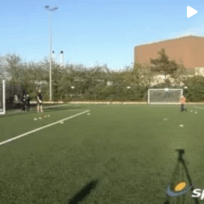
The players spreads out behind the four mini-goals. Player "A" starts with the ball and are up against player "D". As soon as player "A" has scored or player "D" wins the ball (or the ball goes out of play) player D will attack goal "A", which player "A" is going to defend. This means that a quick transition is needed as soon as the player has finished his attack. The players will always first attack one vs one, and quickly go into defending when the attack is finished.
This practice has no coaching points
This practice has no progressions

in more ways than one
 sportplan_football



Deliberate heading is now out of U11 grassroots matches. Here is how to coach chest, thigh and foot control so your players still win the ball in the air.

Long-range goals doubled at the 2026 World Cup as teams sat deep. Here is how to coach when to shoot from distance, the technique, and the follow-up.

Under FutureFit, your Under-9s stay at 5v5, your Under-11s stay at 7v7 and your Under-13s stay at 9v9. Same pitch, same numbers, one more year. Here is how to make sure that year feels like a step forward rather than a repeat.