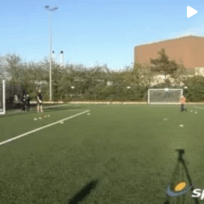
Create a rectangle as shown in the picture. Usinf flat cones separate the attacking square. Place the attacker in the attacking square. Players try to maintain possession by exchanging passes and using the width. As soon as they find an opportunity to provide a through pass to the attacking player they do so. They attacker should always be on the move to take advantage of the gaps created.
As soon as the attacker receives the ball he is allowed to go and score. One of his teammates can join him while one defender should run to prevent them from scoring.
Create two squares to avoid any queues.

in more ways than one
 sportplan_netball


in more ways than one
sportplan_football

Deliberate heading is now out of U11 grassroots matches. Here is how to coach chest, thigh and foot control so your players still win the ball in the air.
Long-range goals doubled at the 2026 World Cup as teams sat deep. Here is how to coach when to shoot from distance, the technique, and the follow-up.

Under FutureFit, your Under-9s stay at 5v5, your Under-11s stay at 7v7 and your Under-13s stay at 9v9. Same pitch, same numbers, one more year. Here is how to make sure that year feels like a step forward rather than a repeat.