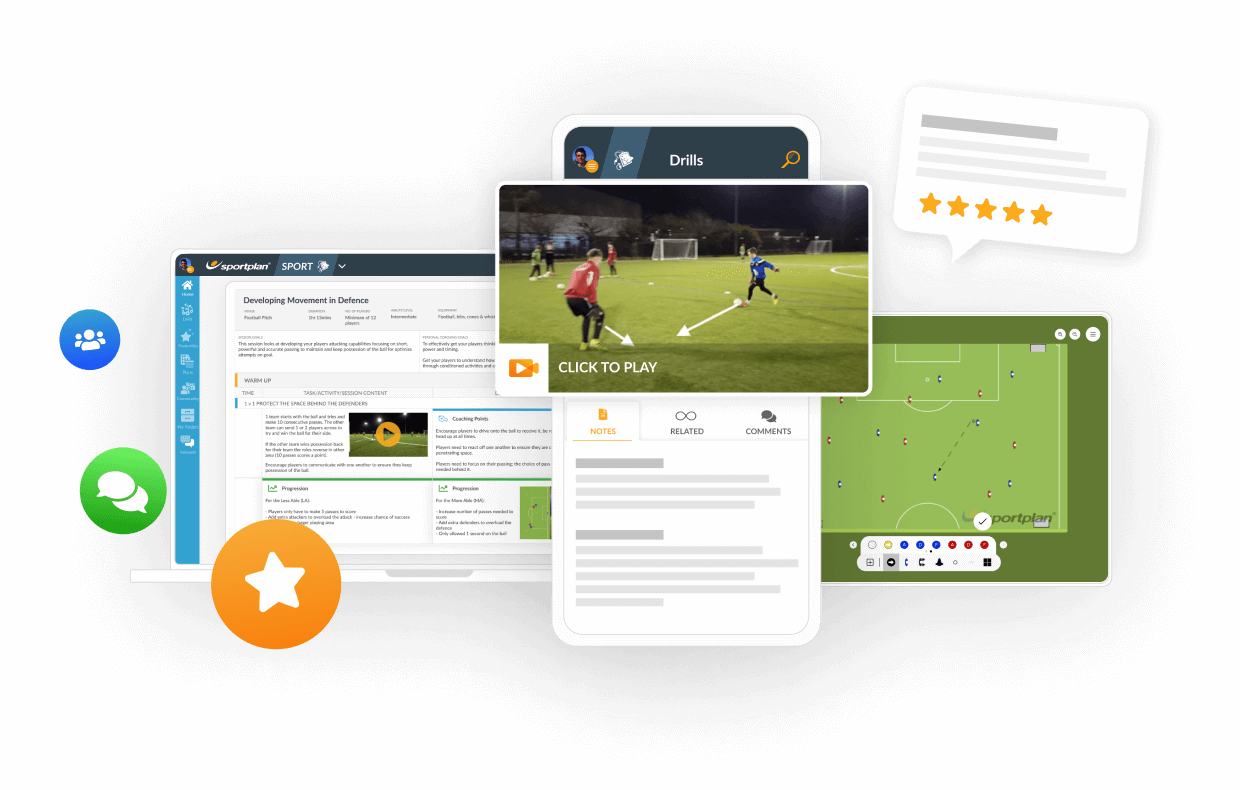
The drill starts on the left side with one of the players in the centre circle chiping a ball to the outside winger who controls the ball and passes to the inside midfielder.
After passing the ball to the midfielder the winger makes a run up the line. The midfielder passes the ball to the running winger who takes a touch, dribbles a short distance and then crosses the ball into the penalty area where two attacking players have made their run into the penalty area starting from the top of the "D" of the penalty area.
One of the attackers tries to strike the ball first time to score at goal, either with the foot or head.
After completing the shot at goal the two attacking players return to the top of the"D". The winger returns to the midfielder position and the midfielder now becomes the new winger.
The drill now starts from the centre circle but from the right hand side.
Two new attacking players now attack the goal. Both attacking players swap positions after each attempt at goal.
One attacking player heads for the front post and the other to the rear post, both making diagonal runs into the penalty area.
1. Control the ball from height
2. Accurate passing.
3. Ability to pass or cross the ball to either attacking player to enable a good strike at goal.
4. Striking the ball with accuracy at goal with either the foot or the head.
5. Timing of the runs.
Variations:
1. Start with multple touches then introduce one touch.
2. Wingers to dribble right to the end line and then cut the ball back.
Great warm up drill before the start of a game.
in more ways than one
 sportplan_netball


in more ways than one
sportplan_football

Under FutureFit, your Under-9s stay at 5v5, your Under-11s stay at 7v7 and your Under-13s stay at 9v9. Same pitch, same numbers, one more year. Here is how to make sure that year feels like a step forward rather than a repeat.

Most 1v1s are lost in the first second, when the defender rushes in and dives. Teach your players to slow the attacker down, take away the dangerous option and pick the right moment, and they will win far more of them.

The FA's FutureFit framework lands this season, bringing a 3v3 entry format at Under-7s. Here is what actually changes on a Saturday morning, and how to coach it well.