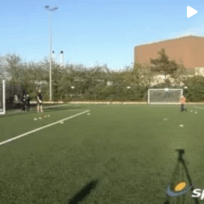
The aim of this drill is to encourage players to think aout finding space individually and not to crowd the ball or an area of the pitch.
Each team has two coned areas
The aim is for the attacking team to send 1 player to infiltrate the opposition space (boxes) and look for a pass
The defending team must also send 1 player to defend the on coming attack
The game should be played as a normal match and normal rules apply.
Encourage the team to communicate effectively
Award the opposition a free kick if the team in possesion crowd too many players round one area (on the ball)
Look for the leaders in the team who send communications to others
Make sure there are no static players in the boxes - Encourage them to time their run intelligently

in more ways than one
 sportplan_netball


in more ways than one
sportplan_football

Deliberate heading is now out of U11 grassroots matches. Here is how to coach chest, thigh and foot control so your players still win the ball in the air.

Long-range goals doubled at the 2026 World Cup as teams sat deep. Here is how to coach when to shoot from distance, the technique, and the follow-up.

Under FutureFit, your Under-9s stay at 5v5, your Under-11s stay at 7v7 and your Under-13s stay at 9v9. Same pitch, same numbers, one more year. Here is how to make sure that year feels like a step forward rather than a repeat.