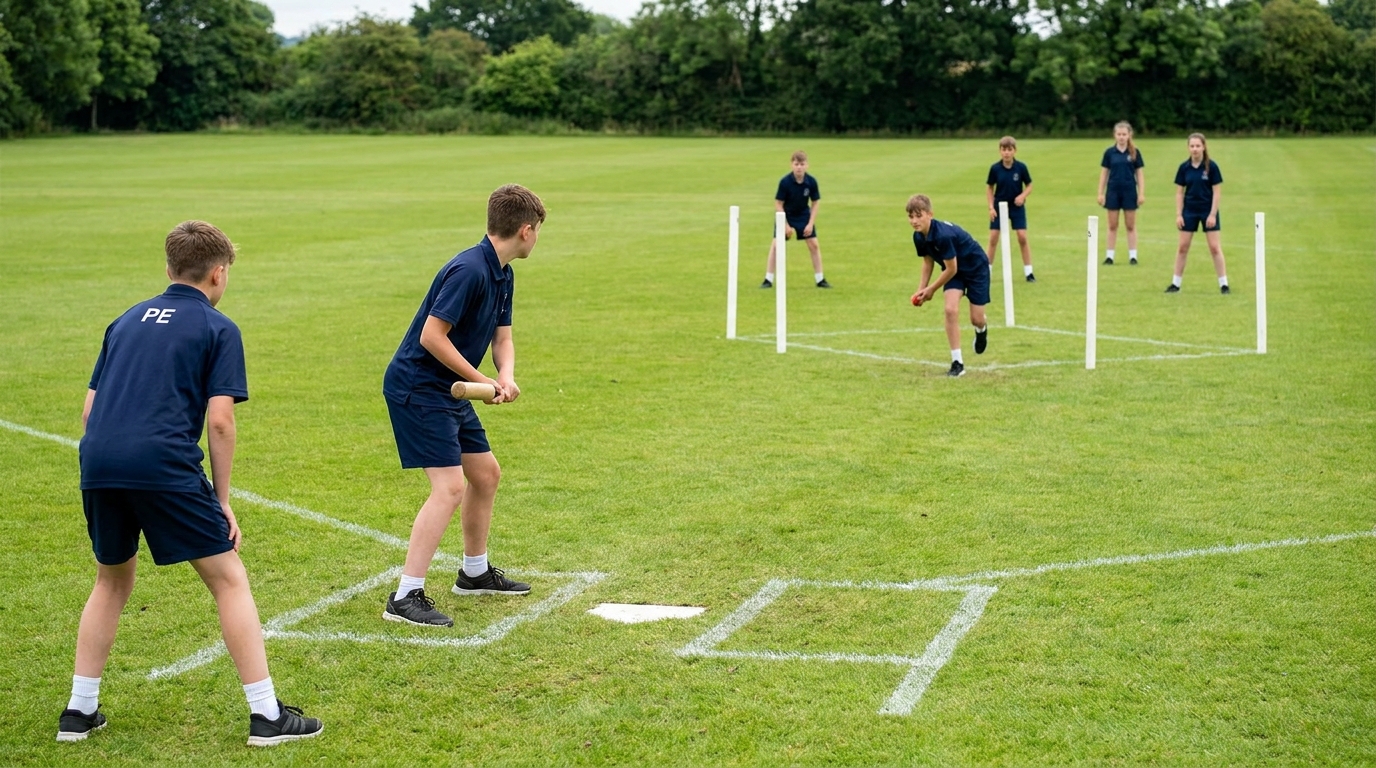
One Bat, Four Posts, Nine Fielders
Rounders looks simple - hit the ball, run round the posts - and at its heart it is. But the first time you watch from the boundary, the calls of "half-rounder!", "stumped!" and "no-ball!" can be baffling. This guide breaks the game down for anyone who is new to it: a player picking up a bat for the first time, a teacher running it in a PE lesson, or a parent trying to follow what on earth is going on.
The game is governed in Britain by Rounders England, and the rules below follow their version of the game. We will cover the two teams, every fielding position and where each one stands, how bowling and batting work, the all-important difference between a rounder and a half-rounder, and the many ways a batter can be given out. By the end you will be able to follow a game - and explain it to someone else.
The Two Teams
Each side has nine players. One team bats while the other fields, then they swap. The batting team sends out one batter at a time to face the bowler; the rest wait their turn. The fielding team puts all nine players out on the pitch - a bowler, a backstop, and the rest spread around the posts and the open ground. A standard Rounders England match is played over two innings, with each innings lasting until all the batters are out (or, in many school and league formats, until each batter has had a set number of balls). The team with the most rounders at the end wins.
The Fielding Positions
The fielding side has nine players and two of them - the bowler and the backstop - have fixed jobs. The other seven cover the posts and the deep ground, and a good captain shuffles them around depending on which way each batter tends to hit. Here is what each does.
Bowler
The bowler stands in the bowling square in the middle of the pitch and bowls underarm to the batter. This is the most important fielding role: a good bowler varies pace and line to make the batter swing at awkward balls, and is also first to react to anything hit straight back. The bowler can field the ball and throw to a post to get a runner out.
Backstop
The backstop stands behind and to the side of the batter, roughly where a wicketkeeper would in cricket. Their job is to gather every ball the batter misses or just clips, and to be ready to "stump" 1st post quickly - touching the post with the ball before the runner gets there. A sharp backstop stops easy half-rounders and turns missed swings into outs. It is one of the busiest jobs on the pitch.

Post Fielders (1st, 2nd, 3rd and 4th Post)
Four fielders stand by the four posts. Their job is to receive throws and "stump" the post - touching it with the ball before a runner arrives - to get batters out, and to keep runners pinned to a post. They do not stand right on the post but a stride or two away, ready to move to the ball and then touch the post. Good post fielders have safe hands and quick feet, because a split second decides whether a runner is in or out.
Deep Fielders
The remaining fielders spread out into the deep areas - between the posts and beyond them - to cut off hard hits and stop the ball reaching the boundary, where the batter would have time to run further. Deep fielders need a strong, accurate throw to fire the ball back to a post in one go. In a 9-a-side game the captain decides how many to push deep based on how powerfully the batting team hits.
The Rules: Bowling
The bowler must bowl underarm with a smooth action. For the bowl to be fair, the ball must arrive within the batter's reach: above the knee and below the head, on the batting side of the body, and not too wide. If the bowl breaks any of these conditions it is a no-ball. The batter may hit a no-ball if they choose, but they can never be out off one - and crucially, on a no-ball they may run to as many posts as they can safely reach. Two no-balls in a row to the same batter give them a free half-rounder in some formats, which is why control matters so much.

The Rules: Batting and Running the Posts
The batter gets one good ball to hit. Whether they hit it or miss it, once they have had their fair ball they must run - they cannot simply stand and wait. The batter runs from the batting square to 1st post, then on to 2nd, 3rd and finally 4th post, always passing round the outside of each post. They must touch each post (with hand or bat) as they pass. If they cannot reach the next post safely, they stop and keep contact with the post they have made, waiting for a later hit from a team-mate to move on.
A runner waiting at a post can only set off again when the bowler does not have the ball ready to bowl. The moment the bowler is set, anyone off a post is in danger of being given out, so runners must keep contact with their post until it is safe to go. Several runners can be on the posts at once, edging round as their team-mates hit.
Scoring: Rounders and Half-Rounders
This is the part that confuses most newcomers, so here it is plainly. A full rounder (worth 1 point) is scored when a batter hits the ball and runs all the way round to 4th post, in one continuous run on their own hit, before the next ball is bowled, without being out. A half-rounder (worth half a point) is scored in two main ways: reaching 4th post without hitting the ball (for example off a no-ball or a missed swing), or reaching 2nd post on your own hit before the next ball is bowled. So a clean hit and a fast lap is a rounder; getting safely round in stages, or off a ball you didn't hit, is a half-rounder.
One more wrinkle worth knowing: a backward hit - a ball that goes behind the batting line - is allowed, but the batter may only run to 1st post and must wait there until the ball returns to the bowling square area before going on. It stops batters scoring easily off cheeky little taps behind them.
Getting Out
There are several ways a batter or runner is given out. The common ones are:
The Ways to Get Out
- Caught: a fielder catches the batter's hit before it touches the ground.
- Stumped at a post: a fielder touches the post a runner is heading for with the ball before the runner gets there.
- Running inside a post: a runner who cuts inside a post instead of going round the outside is out.
- Overtaking: a runner who overtakes the batter or runner in front of them is out.
- Losing contact: a runner off their post when the bowler is ready to bowl can be given out.
When the whole batting team has been put out - or after the agreed number of innings or balls - the two teams swap over and the fielding side bats. Whichever team has scored the most rounders (counting half-rounders as half a point) at the end of the match is the winner.

Rounders Pitch Diagram: Who Stands Where
The diagram below shows a rounders pitch from above. The batter stands in the batting square; the bowler bowls from the bowling square in the middle. The four posts sit in the classic rounders layout, and the fielding positions are marked as labelled dots. Read it alongside the quick-reference list that follows.
A 9-a-side fielding set-up: bowler and backstop are fixed; four post fielders and the deep fielders cover the rest of the pitch.
Putting It Into Practice
Knowing the positions and rules is the first step; the fun starts when players get to use them. Rotate juniors and beginners through every job - batting, bowling, backstop and a spell in the deep - so they understand the whole game rather than getting stuck in one spot too early. Our rounders drills for school and club gives you ready-made practices for each role, and the guide to squad selection and rotation shows how to keep everyone involved across a season.
When you want to build a full session around one skill - say the backstop's stumping or the bowler's control - drop the relevant drills into our free rounders session plan template. And for hundreds more practices sorted by skill, browse the full Rounders drills library or start from the Rounders coaching and club guides hub.
Frequently Asked Questions
What are the positions in rounders?
The batting team sends out one batter at a time. The fielding team has nine players: a bowler, a backstop who stands behind the batter, four post fielders covering 1st, 2nd, 3rd and 4th post, and deep fielders who cover the spaces between and beyond the posts. The bowler and backstop are fixed roles; the rest of the side spreads out to cover the pitch and can be moved around to suit each batter.
How do you score a rounder?
A batter scores one full rounder if they hit the ball and run all the way round all four posts, reaching 4th post before the next ball is bowled, without being out. They must touch each post in order and keep contact with it if they stop. Reaching 4th post in one continuous run on your own hit is worth a full rounder; getting there over several balls, or after a no-ball, scores a half-rounder instead.
What is a half-rounder?
A half-rounder is worth half a point and is scored in a few ways: if a batter reaches 4th post without hitting the ball (for example off a no-ball or a missed swing), or if they reach 2nd post on their own hit before the next ball is bowled. It is the game's way of rewarding good running and getting on base even when you have not completed the full circuit in one go.
How many players are in a rounders team?
In the standard Rounders England game each team has nine players on the pitch, with up to six substitutes allowed in a squad of fifteen. The fielding side uses all nine: a bowler, a backstop and seven fielders covering the posts and the deep areas. For school PE lessons and casual summer games the numbers are often relaxed so everyone gets a go.
How do you get out in rounders?
A batter is out if a fielder catches their hit before it touches the ground; if the post they are running to is 'stumped' (a fielder touches that post with the ball before the batter reaches it); if they run inside a post rather than round the outside of it; if they overtake another batter; or if they lose contact with a post while the bowler holds the ball ready to bowl. When the whole batting team is out, or after a set number of innings, the sides swap over.