Quick answer
A Rounders England pitch has a 2 m batting square and a 2.5 m bowling square 7.5 m in front of it. Posts 1, 2 and 3 are 12 m apart, starting 12 m from the batting square, and 4th post is 8.5 m from 3rd, on the forward/backward line. Allow about 100 m by 60 m of space.
Source: Rounders England marking plan and Official Rounders Rules 2023–2025 (Rule 1).
How to mark it out
- Mark the batting square. Put a peg at its front right-hand corner. The square is 2 m by 2 m, and its front line is extended at least 12 m each way to make the forward/backward line.
- Fix 2nd post. Measure 17 m straight out from that corner and peg 2nd post.
- Find 1st and 3rd posts. Tie a 24 m string between the two pegs with a knot in the middle. Pull the knot taut to the right for 1st post and to the left for 3rd post: each is 12 m from its neighbours.
- Place 4th post. Use a 17 m string knotted at 8.5 m between 3rd post and the batting-square peg; the knot marks 4th post, on the forward/backward line.
- Mark the bowling square and lines. The 2.5 m bowling square's front line is 7.5 m from the batting square's. Add the 6 m backstop line 1 m behind the batting square and 2 m zone lines at each post.
Common questions
How big is a rounders pitch?
The posts are only 12 m apart, but you need space around them: Rounders England's plan uses an area about 100 m wide and 60 m deep, with 10 m behind the batting square for waiting batters.
How many posts are there in rounders?
Four. They stand 1.2 m high in weighted bases rather than being fixed in the ground (Rule 2D), and batters run round them in order from 1st to 4th post.
What shape is a rounders pitch?
Roughly a diamond. The running track goes 12 m from the batting square to 1st post, 12 m to 2nd, 12 m to 3rd, then 8.5 m to 4th post on the forward/backward line.
How do you set up rounders?
Mark the squares and posts, put the bowler in the bowling square and the batter in the batting square, with a backstop behind. Each side can have up to 15 players, with no more than 9 on the pitch at once (Rule 3).
Rounders drills for this
- Bowling Technique
- Batting Technique
- Backing up the post
- 3 ball round the clock
- Rounders positions and rules explained
Organising a school or summer-league side? Teamo, from the makers of Sportplan, keeps fixtures, availability and fees in one app. Find out more about Teamo.
Marking it out with pegs and string
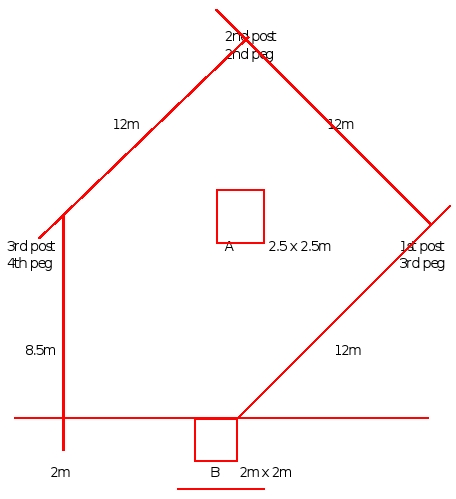
- Put a peg (peg 1) into the ground where the right hand front corner of the batting square
- Directly opposite peg 1 put another peg (peg 2) at a distance of 17m. This will be 2nd post
- Take a length of string 24m long and tie a knot in the center 12m
- Tie one end of the strong at peg 1 and the other end at peg 2, and carry the center knot to the right until the string is taught. Place peg 3 here. This will form 1st post
- Mark 3rd post by carrying the knot to the left until the string is taught. Put in peg 4
- Take a length of string 17m long with a knot in the center 8.5m and tie one end to peg 4 and the other to peg 1
- Carry the knot to the left to mark 4th post where the string is taught
- The batting square is 2m square
- The front line is made by marking a line extending 2m from peg 1 towards and in line with 4th post and parallel to the front line of the bowling square
- Mark the other three sides forming a 2m batting square
- The front line of the square is extended for at least 12m by a solid line
- The bowling square is 2.5m square
- To locate the center of the front line of the bowling square, stretch the 17m string from peg 1 to peg 2
- Measure a distance of 7.5m along the string from peg 1
- The front line is then marked 1.25m each side of the string parallel to the front of the batting square
- Mark the other three sides of the bowling square
- To check the bowling square for accuracy stretch the 17m string from peg 3 to peg 4. The string will cut the sidelines of the bowling square 1m from the front line
The not out batters wait at line C, whilst the out batters wait along line D
All lines mentioned are compulsory