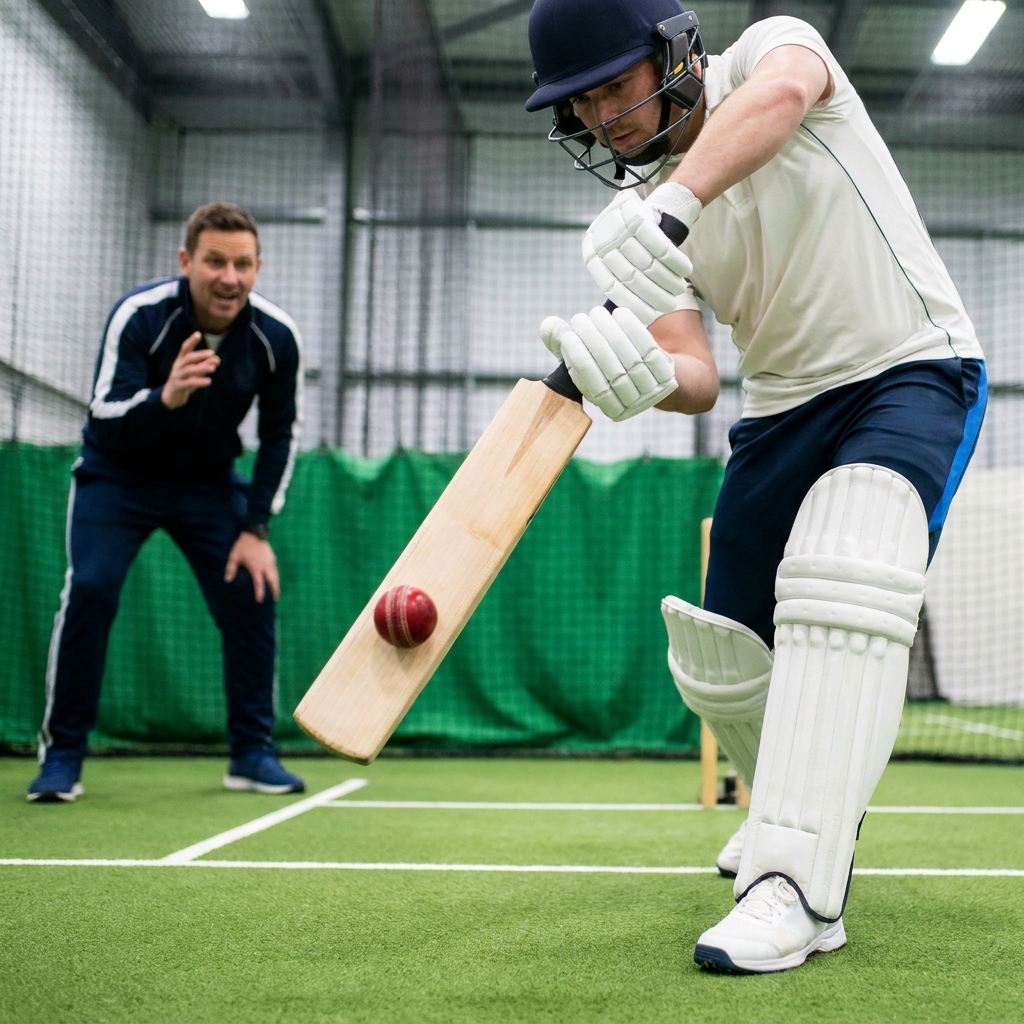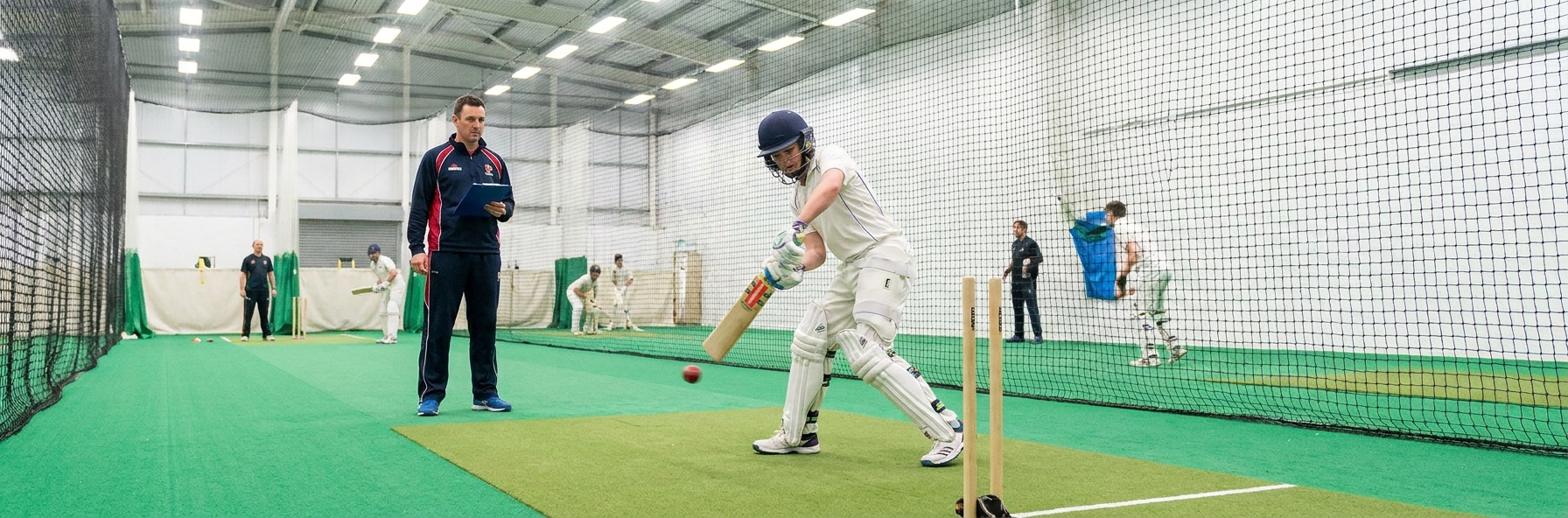
Indoor nets keep a club ticking over through the winter, and for most coaches they are the only option between now and pre-season. But the indoor surface is not a smaller version of a square. It is true, fast and completely consistent, and it quietly rewards technique that falls apart the moment a ball seams or stops on a slow outdoor pitch.
That does not mean indoor nets are a waste of a winter. It means the coaching has to be deliberate. Left unmanaged, players groove a flat-track game against one-pace bowling in a space with no fielders and no real consequence for a false shot. Managed well, the same sessions build genuine technique that holds up when the weather turns.
Why Indoor Habits Do Not Transfer
Three things make indoor nets different, and coaches who ignore them end up undoing the winter's work in the first week outside. The bounce is true and even, so batters stop having to adjust for variable bounce. The pace off the surface is quicker and more predictable, which flatters anyone who commits early and hard to the front foot. And there is no fielding, no real boundary and often a shortened run-up for bowlers, so game-realistic decision-making gets left out entirely.
None of this is a reason to skip indoor nets. It is a reason to coach technique and decision-making on purpose, rather than letting players simply "have a hit".
A Framework for Winter Technical Work
Step One: Diagnose before you drill. Start the winter by watching each player bat and bowl with no coaching input. Note the two or three things that genuinely limit them, not everything that could be tidier. Indoor sessions are too short and too frequent to fix everything at once.
Step Two: Isolate the movement. Use throwdowns, a bowling machine or slow underarm feeds to repeat the specific movement, head position, back-lift, front-foot press, head over the front knee, at a pace the player can control. Volume matters more than bowler pace at this stage.
Step Three: Add realistic pace and length. Once the movement is sound, bring in proper bowling at matched pace so the technique is tested, not just rehearsed. This is where most clubs stop, and it is also where the false confidence creeps in if you do not go further.
Step Four: Force a decision. Build in a reason to choose between defending, leaving and attacking, varied length and a target to protect or chase, so technique is married to shot selection rather than isolated from it.
Step Five: Review on video. A phone propped on a tripod at the side of the net is enough. Players believe what they see far more readily than what they are told, and a short clip compared to the diagnosis from Step One shows real progress over the winter.
How to Train It: A Simple Session Plan
A 90-minute indoor session built around this framework might run: 15 minutes dynamic warm-up and ball-tracking drills, 25 minutes isolated technical work in pairs or small groups using throwdowns or a bowling machine, 30 minutes bowler-fed net time at matched pace focusing on the diagnosed fault, and 20 minutes of a conditioned game that forces a decision, for example a points system that rewards controlled shots and penalises false ones.
Rotate bowlers through genuine pace, not just medium trundlers, so batters are not building false confidence against one speed all winter.
Key Coaching Points
- Diagnose two or three specific faults per player rather than coaching everything at once.
- Use throwdowns or a bowling machine to isolate technique before adding full-pace bowling.
- Build in a decision, defend, leave or attack, so technique is not practised in isolation.
- Vary bowling pace through the winter; a flat, one-pace net builds false confidence.
- Film short clips regularly so players can see progress against where they started.
- Treat the first few outdoor sessions of pre-season as a reset, not a formality, since bounce and seam movement will expose anything indoor nets let slide.
Recommended Drills


VIEW ALL FRONT-FOOT BATTING DRILLS
Frequently Asked Questions
How many times a week should club cricketers do indoor nets over winter?
Once a week is enough to maintain and build technique without it becoming repetitive drudgery. What matters more than frequency is structure: a session with a clear diagnosis and purpose beats three sessions of unstructured hitting.
My batters look great indoors but struggle the moment we go outside. What went wrong?
This is the classic indoor trap. True, even bounce and consistent pace let players get away with a flat-footed, front-foot-heavy game that outdoor bounce and seam movement exposes immediately. Build variable bounce and pace into the winter programme, through the bowling rotation and decision-making games above, so the transition outdoors is not a shock.
Is it worth using a bowling machine for winter technical work, or is bowler feed always better?
Both have a place. A bowling machine is excellent for isolating a specific movement with total repeatability, which is ideal early in the diagnosis-and-correction process. Bowler feed is essential before the winter is out, since it reintroduces the variation, pace changes and visual cues that a machine cannot replicate.