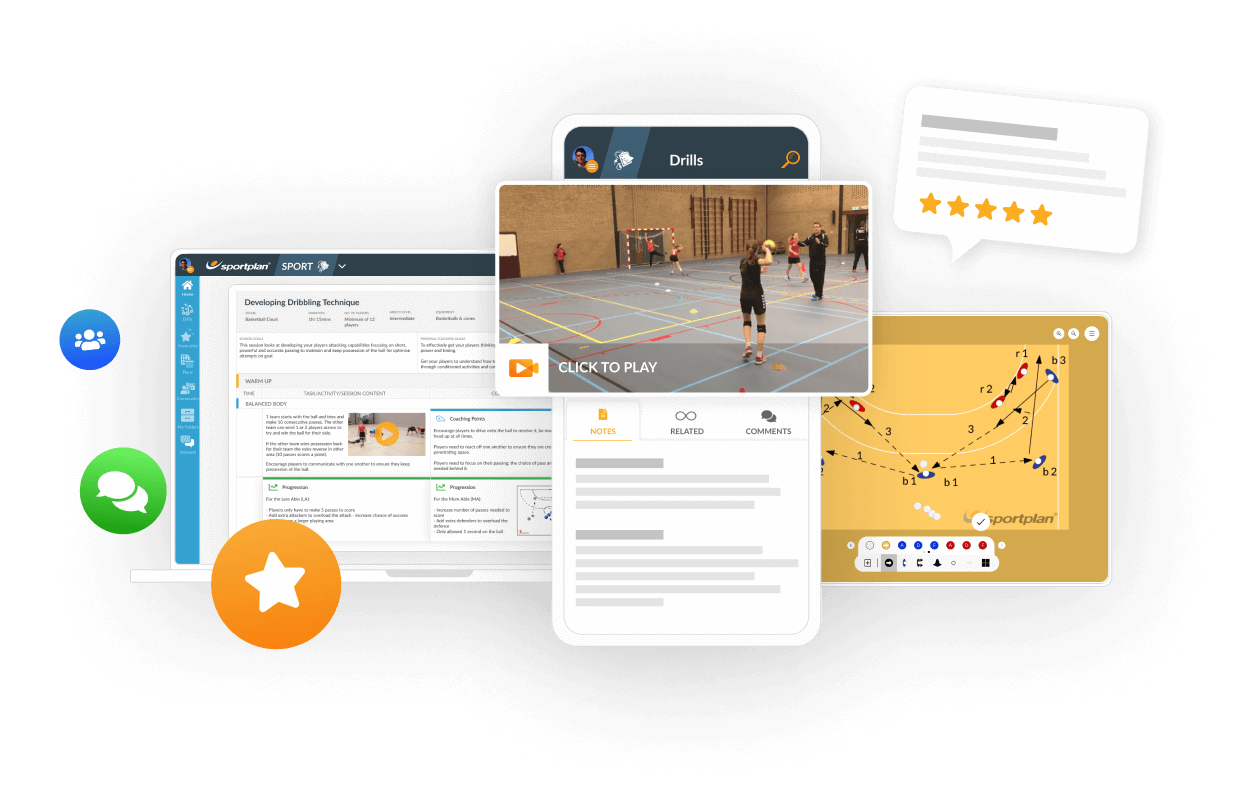
After being passed the ball by the feeder/coach the attackers (blue 2 and blue 3) try to pass their way past the defenders.
In this drill the two attackers can attack anywhere, and can overlap and swap positions at will in order to try and get past the defenders.
The defenders however must mark the space, not the players, and so must communicate between one another so that both players are always marked, while ensuring that they don't change places.
The defenders will need to communicate well between one another in order to be successful and not let the attackers though.
Before starting this drill you might like to quickly ask your players what would be the best calls defenders could use when defending players who like to switch positions i.e. Your man, on your right shoulder, swap player etc...
Defending in a personal duel
- Take small steps forward.
- arms are slightly bent and in front of you
- Make contact with bent arms on shoulder of trunk of opponent.
- Press and guide the attacker.
- Bent knees, front part of feet.
- Make short but fast side-steps.
- Control the attacker from the front.
Wing players operate in the most demanding shooting position on a handball court, where acute angles and a close goalkeeper make finishing a specialist skill. This article breaks down the technique, decision-making, and training progressions that coaches need to develop elite wing finishing.
The transition from attack to defence is the most vulnerable moment in handball. This article examines the 3-second recovery principle, the specific roles players must adopt during transition, and the training scenarios that build a team's ability to recover defensive shape under pressure.
Handball demands explosive power, repeated sprint ability, and the strength to compete physically for 60 minutes. Sport-specific conditioning develops the athletic qualities that underpin elite performance.