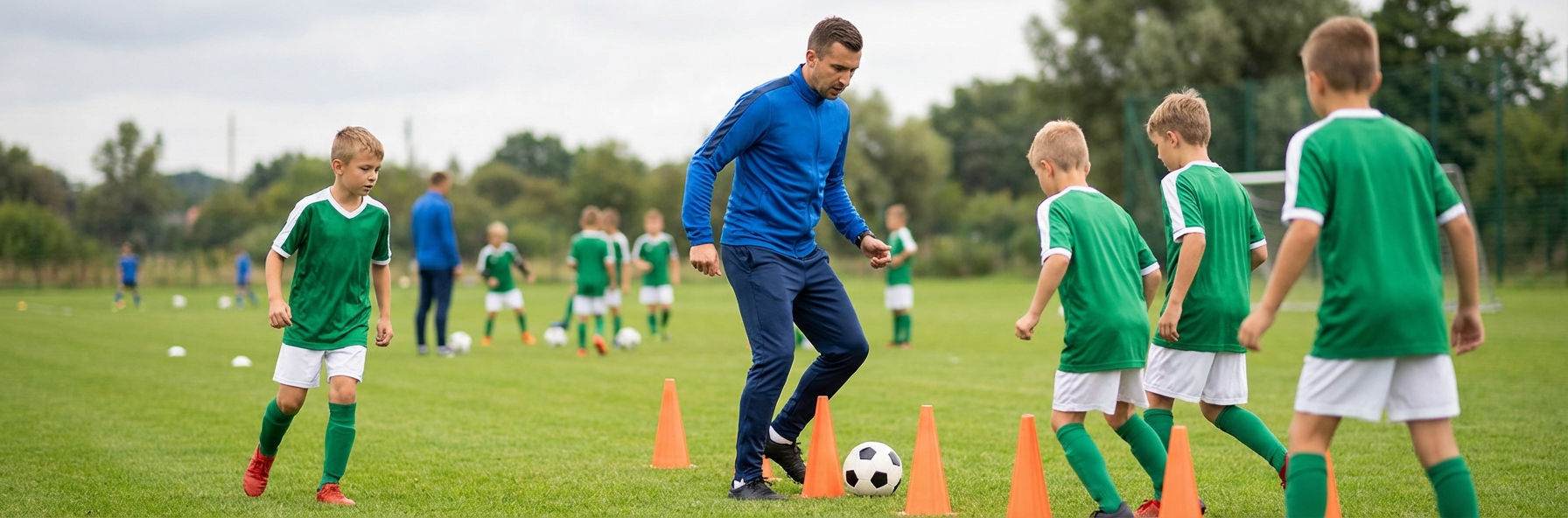
Ask any professional footballer when they developed their close control and they'll point to childhood. The hours spent with a ball at their feet between ages 7 and 10 created neural pathways that can never be fully replicated later. This is why U10 coaching matters so much - and why getting it right is so important.
At this age, children are neurologically primed for skill acquisition. Their brains are hungry for movement patterns. Your job isn't to teach tactics or winning. It's to maximise their time on the ball in environments that challenge their feet and their minds.
The Philosophy: Touches Over Tactics
Every elite development programme in the world prioritises ball mastery at U10. The logic is simple: you cannot play football at higher levels without excellent control. Technical ability developed now becomes the foundation for everything that follows.
This means your sessions should maximise individual touches. Long lines, waiting for turns, and 11v11 matches are the enemies of development. Small groups, lots of balls, and constant movement are your allies.
Drill 1: The Ball Mastery Circuit
Setup: Each player has a ball and a small working space (3x3 yards).
Sequence (30 seconds each):
- Toe taps on top of the ball
- Side-to-side rolls with the sole
- Pull-push (pull back with sole, push forward with laces)
- Inside-outside touches while moving
- Foundation turns (inside hook, outside hook, drag back)
Key point: Quality over speed initially. Once the technique is clean, add tempo challenges.
Drill 2: Cone Forest
Setup: Scatter 20-30 cones randomly across a 20x20 yard area. All players have balls.
Task: Dribble through the forest without hitting any cones. On the coach's whistle, perform a specific move (step-over, Cruyff turn, scissors) and continue.
Why it works: Random cone placement forces constant scanning and adjustment. The ball is always at their feet, but their eyes are up.
Drill 3: Dribble Tag
Setup: 15x15 yard area. Everyone has a ball except two "taggers."
Rules: Taggers try to touch dribblers. If touched, you swap roles. Dribblers must stay within the area and maintain close control.
Progression: Taggers also have balls and must dribble while chasing.
Why it works: Combines dribbling with awareness and decision-making. The competitive element maintains engagement.
Drill 4: 1v1 Boxes
Setup: Multiple 10x10 yard boxes, each with two small goals at opposite ends. Pairs of players in each box.
Rules: Continuous 1v1s. Score in either goal. Ball out of play = restart immediately from coach's feed.
Why it works: Maximises game-realistic dribbling situations. Players learn to use moves to beat an opponent, not just for show.
Drill 5: The Gauntlet
Setup: Narrow channel (3 yards wide, 15 yards long). Two passive defenders stand in the channel. Dribblers start at one end.
Task: Dribble through the channel and exit the other end. Defenders can move sideways but not forward.
Progression: Make defenders active. Add a third defender. Narrow the channel.
Why it works: Teaches children to dribble under pressure and use body feints in tight spaces.
Creating the Right Environment
U10 players need encouragement, not criticism. Every attempt at a skill should be praised, regardless of outcome. The player who tries a step-over and loses the ball is developing faster than the one who plays safe every time.
Keep instructions minimal and demonstrations brief. Children learn by doing. The more time they spend watching you talk, the less time they spend with the ball at their feet.
Session Structure
A typical 60-minute U10 session should look like this:
- 0-10 mins: Ball mastery circuit (individual)
- 10-20 mins: Dribbling game (Cone Forest or Dribble Tag)
- 20-35 mins: 1v1 activity (1v1 Boxes or Gauntlet)
- 35-55 mins: Small-sided game (3v3 or 4v4)
- 55-60 mins: Free play or skill challenge
Notice there's no 11v11. No set pieces. No tactical instruction. That comes later. Right now, we're building footballers.
The Long Game
The best U10 coaches resist the pressure to win matches. They understand that a child who can dribble past three players but loses the ball sometimes is developing beautifully. That same child, coached to play safe, might win more games now but will hit a ceiling later.
Your measure of success at this age isn't league position. It's whether your players are better on the ball in March than they were in September. That's the only metric that matters.
 sportplan_football