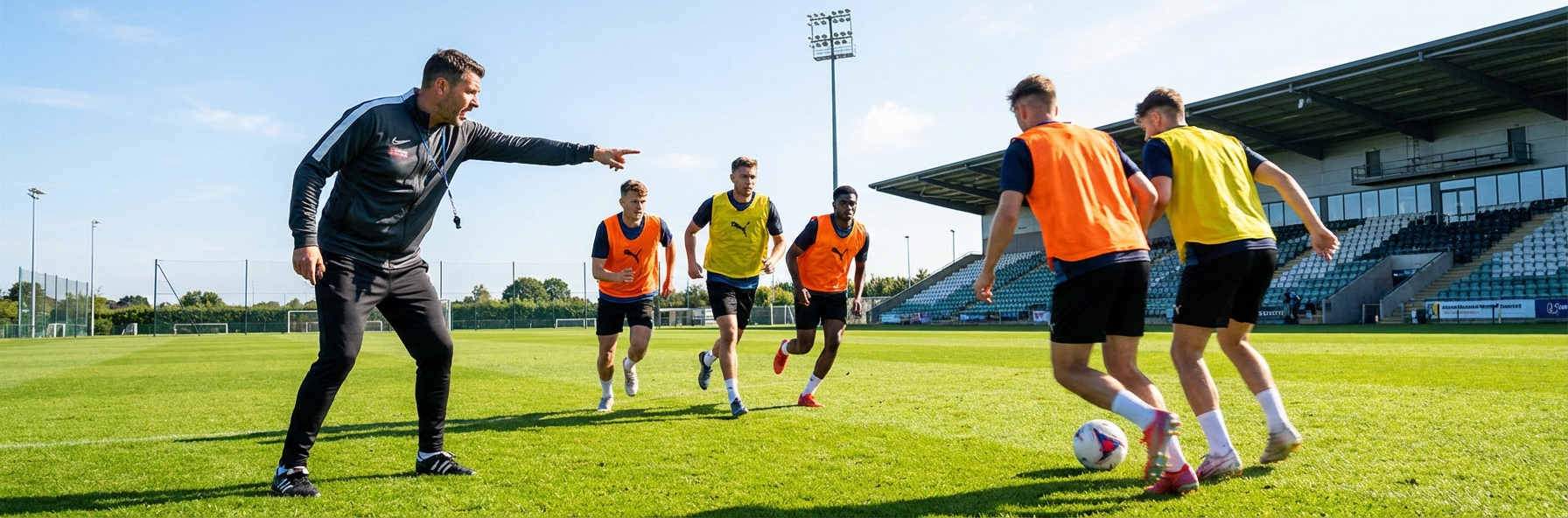
Three attackers, two defenders, and a goalkeeper who's wondering why nobody tracked back. Sound familiar? The 3v2 overload is one of football's most common and most dangerous situations. Get it wrong and you're fishing the ball out of the net. Get it right and you've turned a crisis into a clearance.
The good news? Defending overloads isn't about athleticism or luck. It's about understanding a few simple principles and drilling them until they become instinct.
Why Overloads Happen
Teams don't plan to be outnumbered. Overloads occur when possession changes quickly and players are caught on the wrong side of the ball. A misplaced pass in midfield, a corner that gets cleared, a striker who loses possession - suddenly the opposition is running at your backline with numerical advantage.
The first principle of defending overloads is accepting they will happen. Every match. Multiple times. The question isn't whether you'll face a 3v2. It's whether your defenders know what to do when it arrives.
The Golden Rule: Delay
Your primary job in a 3v2 is to slow the attack down. Every second you buy is a second for teammates to recover. Every yard you force the attackers to travel sideways is a yard they're not travelling toward your goal.
The nearest defender must engage the ball carrier without diving in. Close the space, show them wide, force a decision. The moment they have to think is the moment the attack loses momentum.
Positioning: The Triangle
Your two defenders should form a triangle with the ball carrier at the apex. The first defender presses the ball. The second defender drops deeper and narrower, covering the most dangerous pass (typically the central option).
This staggered positioning means you're never flat. Even if the ball carrier beats the first defender, the second defender is already in position to engage.
Communication Is Non-Negotiable
In a 3v2, the covering defender becomes the organiser. They can see the whole picture. Their job is to direct the pressing defender: "Show him left." "Don't dive in." "I've got the runner."
Silence kills. Two defenders making individual decisions will be picked apart. Two defenders working as a unit can frustrate any attack.
The Decision Point
At some point, the attackers will commit to a final action - a shot, a through ball, or a cross. Your defenders must recognise this moment and react appropriately.
If the ball carrier shoots, the nearest defender blocks. If they play a through ball, the covering defender intercepts or shepherds the runner away from goal. If they cross, the goalkeeper claims or the covering defender clears.
The key is staying patient until this moment. Too many defenders try to win the ball early and get beaten, leaving the goalkeeper exposed.
Training the Principles
Drill 1: Controlled 3v2
Set up a half-pitch with two defenders and a goalkeeper facing three attackers. The attackers start from the halfway line. Play is live until a shot, a save, or a defensive clearance. Rotate roles every 3-4 repetitions.
Drill 2: Transition Overload
Play 4v4 in a central zone. When the attacking team loses possession, two players must retreat to defend while the other team breaks forward 3v2. This replicates the chaotic nature of real transitions.
Drill 3: Recovery Runs
Start with attackers at the halfway line and defenders on the edge of the box. On the coach's signal, attackers advance with the ball while one defender sprints to recover. This trains the habit of tracking back and joining the defensive action.
Mental Preparation
Defenders who panic in 3v2 situations have usually been told they shouldn't be there in the first place. Change the narrative. Teach your players that defending overloads is a skill, not a failure. Praise intelligent defending as highly as clean sheets.
The defender who delays a 3v2 long enough for a midfielder to recover has done their job. The defender who blocks a shot at the last moment has done their job. This is defensive success, even if it doesn't look pretty.
When to Commit
Sometimes delaying isn't possible. If the ball carrier has a clear shot, the nearest defender must try to block. If a runner is about to receive in a goal-scoring position, the covering defender must intercept.
These moments require bravery. Train your defenders to recognise when patience becomes passivity and when decisive action is needed.
The Goalkeeper's Role
A goalkeeper facing a 3v2 must narrow angles aggressively. They're the last line. If a shot is coming, they should be set and balanced. If a pass is played wide, they should adjust their position instantly.
Communication from the goalkeeper is also vital. They can see runs their defenders can't. A simple "man on" or "hold your line" can make the difference.
Bringing It Together
Defending 3v2 is uncomfortable. It should be. You're outnumbered and every option looks dangerous. The teams that handle these situations best are the ones who have trained the principles until they're automatic.
Delay. Communicate. Stay patient. Commit at the right moment. Do these things consistently and you'll turn a nightmare into something manageable - and occasionally, into a counterattack of your own.
 sportplan_football