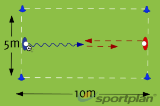
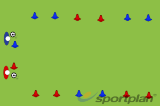
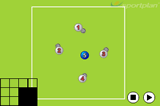
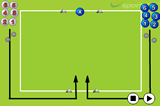
Station one player in each grid in the crab postion (belly up, on hands and feet). Six players start on one end line. Station discs at the opposite end line.
The standing players must dribble across the area without being tackled by the crab players who are trying to kick the balls out of the area. If a ball is kicked out, the player stays in the game and tries to help his teammates get the other balls across. The object of the game is to see how many times the players can dribble across the area until no soccer balls are left. Count how many successful trips players make. Repeat and rotate.
Push the ball 2-3 feet in front of you between touches. When approaching a defender, push the ball into an open space to his side and accelerate into the space.
If you have lost your ball, get in a space where a teammate might pass to you.
Two ways to beat a defender: pass or dribble.

in more ways than one
 sportplan_netball


in more ways than one
sportplan_football

Four Halloween-themed games sneak a full warm-up, finishing, rondo and small-sided game into one junior football session this week.

Deliberate heading is now out of U11 grassroots matches. Here is how to coach chest, thigh and foot control so your players still win the ball in the air.

Long-range goals doubled at the 2026 World Cup as teams sat deep. Here is how to coach when to shoot from distance, the technique, and the follow-up.