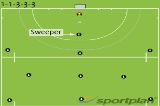
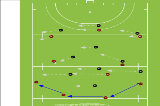
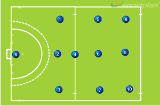
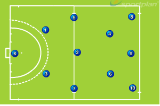
1-1-3-3-3 formation

This set-up will see your team playing with a sweeper behind the back 3. The advantage of this system is that there is always a covering player to support the back 3 defenders. Your back 3 can play this 2 ways: Man to man back 3, with players sticking with the same player or Zonal defending. Players stay in position and mark any player that comes into their area. With this system you would look to attack using the width from the back. When to use: This system is good when: You have a slow back 3 players who keep being out run by forwards. The opposition is better and keep beating one of your back 3 The opposition throw good long aerials landing in your 25.

Roles and Responsibilities

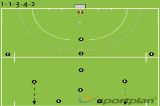
1-1-3-4-2

This system gives support to the backline as well as the midfield. It relies on the 2 forwards to do a lot of running in defence and play further forward when their team is in possession. When to use: If your team is very fit and want to force the other team back by creating overloads in your defence and midfield.

Roles and Responsibilities

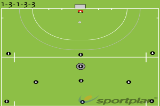
1-3-1-3-3

This system is more attacking then the sweeper behind system (1-1-3-3-3). The advantage of this set-up is that you have a free player behind the midfield (highlighted). This creates a numerical advantage for your team in the middle. This overload will help your team, especially your attackers, to push forward and penetrate the opposition's circle. When not in possession you will have an extra man to support your midfielders. This arrangement gives more opportunities to 1/2 court press and/or full press the opposition. When to use: You would employ this system if your midfiled is being overrun and is struggling to cope with the opposition, but your back line is coping with their players.

Roles and Responsibilities

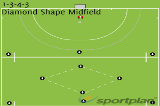
1-3-4-3 diamond shape midfield

4 man midfield with the centre half pushing up higher up the pitch, supporting the front 3 and the midfield. When to use: This formation will help the team to transfer the ball when in possession.

Roles and Responsibilities

1/2 Court Press

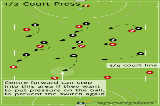
The 1/2 court press is again a team effort and relies on all players joining in and being disciplined. The 1/2 court press is a bit like space invaders - players must move as one unit, from side to side in front of the ball. It is very important that once the ball has gone into the zone, past the highest defenders, the team goes in to full court press mode. But when the ball is played back out of the 1/2 court zone the 1/2 court disciplines have to be adhered to once again. The advantage of the 1/2 court press is that it is easier than taking the initiative, also less agreements need to be made compared to the full press. When to use: The Half court Press is very good for the underdog team that is not able to create chances from their own possession. So using this system you choose to let the opposition have most of the possession and wait for them to make a mistake. Your team will create lots of break opportunities because with every loss of possession the opposition will leave a large amount of space behind them which your side can exploit for the break.

Roles and Responsibilities

Channelling Practice Proud to Coach

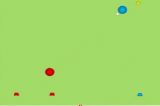
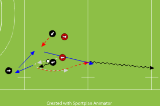
Suggested Exercise Player one begins with the ball in the opposite diagonal corner to player two. Player one’s target is to score through the red cones which are defended by player two. Player two’s aim is to run in an arc towards player one and channel the attacker away from the red cones and force them to the blue cones. Attacking players could begin the exercise passively, allowing the defending player to practice their channelling technique. The exercise could progress to become more game like with the attacking player becoming less passive and attempting to score through the defending player’s goal by eliminating the defending player.

Roles and Responsibilities

Channelling Proud to coach

Difficulty of the skill: Red - a difficult core skill for ages 7-9 years and upwards. As players progress and develop the difficulty of the skill should reduce. What does it mean? Closing down and dictating to the ball carrier where they can and cannot move with the ball. The defending player looks to channel the ball carrier in order to make them either push the ball off the pitch; create a tackling opportunity ;or to provide another teammate with an opportunity to make a tackle. Example of the skill Channelling enables the defender to have maximum control of the situation. If in the middle of the pitch the defending player would look to channel the player towards their (defending players) right hand (open stick side) or alternatively to either a teammates stick or towards the sideline.

Roles and Responsibilities

Cover and Delay - Proud to Coach

Roles and Responsibilities

Defensive Transfer 2

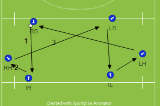
Introduce Inside Left and Inside Right and passing option as indicated on diagram Add in passive defenders

Roles and Responsibilities

Defensive Transfer

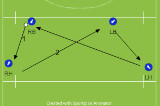
Important players play at match intensity. Scan before receive, let ball come right past right foot, drive forward and peal out strong. LH and RH role - drive line at pace, occasionally cut inside, drop back and pass. LB and RB role - protect the ball, quick early ball wide, moving forward and scanning.

Roles and Responsibilities

Full Court Press

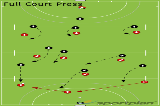
The difference between the Full Press, which puts pressure on the specific areas on the pitch (wide areas in the opposition's 23m area) and the Full Court Press is that pressure is apllied on all areas around the pitch. Each player marks their man tightly and looks to step in front of their man. When to use: When you want to keep the opposition as far away from your goal, and to prevent the opposition's backline from playing the ball around (ideal when the opposition's backline are skilled at passing the ball out).

Roles and Responsibilities

Full Press - Puting Pressure on the Opposition

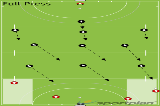
The basis of the press is that no player commits to the ball but a team screen is set up in the decided territory of the pitch. The aim is not to try and steal the ball from the opposition, but instead to make the opposition give the ball to you. By pushing up you are trying to make the opposition make a mistake in trying to run or pass the ball out of these areas. After intercepting a bad pass your team should be looking to break and score. When to use: The Full Press should take place only if: The opposition has a free hit in one of the 2 zones shown in the diagram. Or a player in possession in the 23m area is given a very bad bobbly pass to their reverse stick side. However, this is slightly harder to read as all players need to react, because of this this tactic is probably not worth exploring to begin with. Your team's press should prevent all lateral (sideways) passes across the pitch. All other passing options are easier to close down if you use the side lines to your advantage.

Roles and Responsibilities

halfcourt press with switch denial player high up the pitch

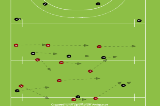
When playing against a half court press with a high forward that puts pressure on the direct switch pass the transfer tends to have to go via the 1st support defender which tends to slow the transfer down so when the ball gets to the opposite wide defender the opposition will have the press in place. Also if the team in possession tries to force the ball into the midfield the press tends to close in and the pressure tends to lead to ball turnover of ball and a break for the defending team on top of of this the attacking team tends have either midfield or forwards in the channels down the line available to receive the pass. If this pass is given once again the press will close down on the player in possession and turn over ball is likely to follow.

Roles and Responsibilities

Outletting through midfield

We will be working on this kind of move in the midfield these next couple of weeks So we are able to outletting the ball via a wall pass into behind the midfield. We may add some rotations into the last few weeks sessions as well

Roles and Responsibilities

Positional Roles - With and without possession

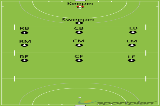
When team in possession of the ball: Keeper To get the ball out of the circle Maybe set-up an attack Sweeper Directs the play from the back Assists with transferring the ball Takes your 16 yard hits Supports the midfield when higher up the pitch CB Makes themself available to assist when playing the ball from the back RB/LB Be in position to receive the ball wide on 16-yard hits Support the midfield when in possession CM Always available to receive the ball. Looks to spread the ball, using their central connection point to help their whole team Take a lot of the free hits RM/LM Very important link in the attacking patterns Supports the forwards by moving up the pitch Should sometimes take players on Should offer a passing option to the defence Should also be able to score CF Try to get free from their marker Pull defenders out of position to create space for other players to explore Able to receive the ball when being man to man marked Needs to be able to take players on in the one to one Able to shoot from all positions and win rebounds Able to win short corners RF/LF Keep wide to receive the ball Able to take on players Can take some risks Should try to cross the ball into the circle Able to win short corners

Roles and Responsibilities

simple press

This animation is made to show my team The way we set up our press and where each player moves according to where the ball is.

Roles and Responsibilities

The 3 - 1 - 3 - 3 formation

This document explains the 3 - 1 - 3 - 3 formation. The European Sweeper System is a naturally fluid one; currently played by the majority of the leading league clubs and national teams....

Roles and Responsibilities

The 5 - 3 - 2 formation

This document explains the 5 - 3 - 2 formation. This framework reflects a structure that has 5 forwards, 3 half backs, 2 backs, and goalkeeper, it is very similar to structures often described as 3-3-4 or ......

Roles and Responsibilities

Tracking Back

- Ball is fed into a forward on the half way line T- spot - Two defenders - One defender is set slightly ahead of the forward - The second defender is on the half way line, and must run back to assist his team once the initial ball has been fed in

Roles and Responsibilities