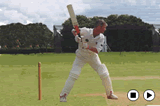
Back Foot Defence

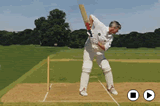
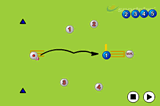
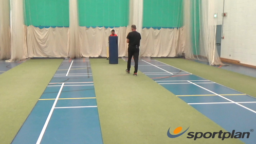
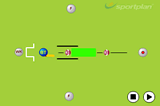
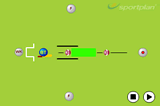
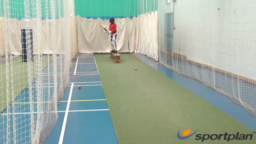
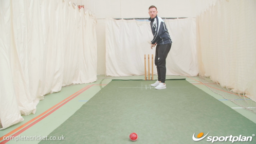
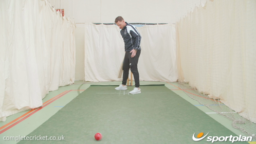
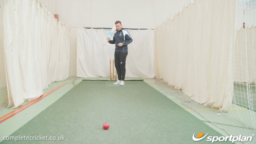
To play this defensive shot properly players will need to think about their whole body's position in order to avoid popping the ball up for an easy take.

Back foot batting

Back foot defence

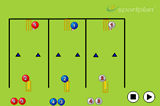
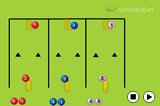
3-5 people stand in each net, with one bowler and the others waiting to receive the ball. Each bowler bowls 24 balls with the batsman getting 3 consecutive balls. If the batsman decides to leaves one of the balls then they may have another ball. On receiving 3 balls the batsman must join the back of the queue.

Back foot batting

Back foot defence: Playing in the V

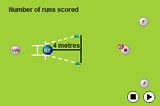
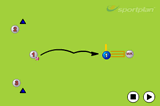
Set up in groups as shown: one batsman, one wicket keeper, one feeder and one or two fielders. Mark out the V area with chalk or cones, approximately 4-5 metres wide. The batsmen has to try and hit the ball between the cones to score runs, if they do they get one run, if not, they lose two runs.

Back foot batting

Back foot Drive

Back foot batting

Back foot drive

Played to a ball short of a length, roughly stump high.

Back foot batting

Back Foot Drive Game

The Coach throws each player 3 balls which they should aim to hit towards the left or right target. If the ball is successfully hit towards the target the batting player must complete 2 runs. If a boundary is hit then the batsman gets another ball. If you leave the ball you get another ball. If you hit behind or outside the coned area you are out (or minus 4 runs)

Back foot batting

Back-Foot Defence

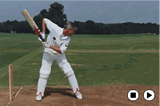
Played to a ball short of a length, roughly stump high. Batsman should have a relaxed and balanced stance - head still, eyes level. Back swing and step back. Their front shoulder should then dip. With the base established, weight stays slightly forward. Shoulders rotate vertically, front leg drawn back, alongside the back foot. Bat decelerates, ‘soft hands’ upon impact. Ball contact under eyes.

Back foot batting

Backfoot defence

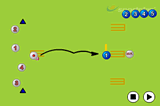
(for age 6-8 use footballs or giant tennis balls, for age 8+ use tennis balls) Six feeds each practice, then rotate clockwise. One bounce football thrown in, feed on one knee. NOTE Safety: No attacking shots (OUT!)

Back foot batting

Backfoot Drive

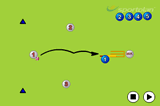
Each batter gets 6-8 feeds each. The throwing player feeds from on one knee and then all rotate after 6 feeds. If a wide ball is thrown or the batter decides to leave the ball they may have an aditional feed.

Back foot batting

Backfoot Drive

Split the group so there is between 3-6 people in each net (including thrower or use coach). The thrower stands at the stumps whilst the rest queue up to bat at the other end. Two cones are placed to provide the target to drive the ball through. Each batsmen gets 2-3 consecutive balls then must go to the back of the queue. If the ball is left they may have another go. Once the batsmen drives the ball through the cones he must run to the stumps and back. Feeding: Each batsmen receives 24 balls and must be from a kneeling or standing position (depending on age and height). The ball should be short of a length, away from the batsmen, bouncing between knee and waste height. Competition: To score 30 runs without getting out, with any shot played into the air being out. Competitions can also be set up between groups to see which group of batsmen can get the highest score with the thrower being from an opposition group.

Back foot batting

Backfoot survival game (8 a-side)

Split your group into two teams, with the coach feeding the ball. There are two ways you can play this game: 1) All players have 4 feeds each. Players are out after their 4 bowls or if they are caught out. 2) Players bat until they reach 20 points, at which point they retire. Players score a point every time the ball is played between the cones.  

Back foot batting

Cutting & Pulling With Power

**AUDIO DESCRIPTION ON** For the pull shot, coach stands with the bag directly in front of the batsman. Coach applies pressure to the bag, against the hitting direction. Batsman plays a pull shot, striking the bag and holding the pose. For the cut shot, coach stands with the bag at the side of the batsman. Coach applies pressure to the bag, against the hitting direction. Batsman plays a cut shot, striking the bag and holding the pose.

Back foot batting

Group coaching for the back foot defence

(see c50024a & c50024b for more info) Set up for the practice Think enjoyment minimises boredom and encourages repetition (repetition -> development) 1. Set up practice as shown in diagram. 2. Markers on the floor for fielders to stand on, should be 3 metres from the batsman. Be strict on this point - safety . 3. Mark out the target area for feeder to aim at for the back foot defence. 4. Ideal number for each group is 4-5 players - maximun activity 5. Feeder kneels 7-10 paces from the batsman. 6. Feeder says \"Bat Up!\", then feeds a dart feed , standing up, throwing from head height downwards. The ball should be aimned to bounce once and between the batsman's waist and chest height. 7. Each group has 3 balls. 8. Ideal duration of practice: 20-30 mins.

Back foot batting

Group coaching for the back foot defence

(see c50024 & c50024a for more info) Coaching points (in order of importance) For younger players, introduce one point at a time. 1. High backlift over off stump with dominant top hand. (Bottom hand fingers and thumb grip.) 2. Step back and across the crease, getting head and body into line with the ball (eyes level). 3. Weight on back foot, whcih lands parallel to crease (head left forward of the body). 4. With dominant top hand and diamond shape formed with arms, Push bat towards the ball. (Forearms passing close to body.) 5. Strike ball forward of body, directly below eye level. 6. Keep leading elbow high, close to head. 7. Bottom hand fingers and thumb grip. 8. Top hand dominates throughout the shot. 9. Look through the handle of the bat on completion of the shot. (Head directly above hands, and in line with back foot.) Play the ball with soft hands, so it rolls back up the wicket. Aims of the practice To protect the wickets and leave the wide balls; also to defend the ball straight back up the wicket (between the two parallel lines shown in the diagram). This is the furthest point away from the fielders. If you feel you are going to play the ball outside this line on the off side, leave it alone as it is too wide to play at.

Back foot batting

Group coaching for the front foot defence

(see c50016a & c50016b for more info) Set up for the practice Think enjoyment minimises boredom and encourages repetition (repetition -> development) 1. Set up practice as shown in diagram. 2. Markers on the floor for fielders to stand on, should be 3 metres from the batsman. Be strict on this point - safety . 3. Mark out the target area for feeder to aim at for the back foot defence. 4. Ideal number for each group is 4-5 players - maximun activity 5. Feeder kneels 7-10 paces from the batsman. 6. Feeder says \"Bat Up!\", then feeds a dart feed , standing up, throwing from head height downwards. The ball should be aimned to bounce once and between the batsman's waist and chest height. 7. Each group has 3 balls. 8. Ideal duration of practice: 20-30 mins.

Back foot batting

Hitting On Top Of The Ball

**AUDIO DESCRIPTION ON** Set up a bench at the crease for the batsman to stand on. Batsmen stand in set position. The ball can either be thrown or fed through a bowling machine. Straight balls should be pulled by the batsmen and wide balls outside the off stump should be cut.

Back foot batting

Ian Bell - Back Foot Defense

Similar to the forward defense, this shot is played when the batter feels a good ball has been bowled and no runs can be scored from it. A good defense is needed for batters to bat for long periods and to score runs.

Back foot batting

Ian Bell - Cut Shot

Batters need to capitalise when bowlers miss their length and bowl it wide. There are a number of different cut shots which can be hit in different areas. In this drill Ian Bell talks through how to get into the correct position with some key points you can use.

Back foot batting

Ian Bell - Pull Shot

The pull shot is a counter attacking shot to a fast delivery generally pitched half way down the wicket. Often played incorrectly but if executed well can score your players a lot of runs and force bowlers to pitch the ball up which will be easier to face.

Back foot batting

Pull Shot

Back foot batting