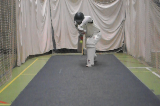
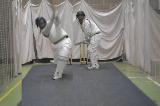
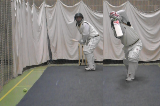
Ian Bell - The Set Up

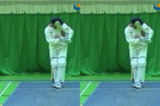
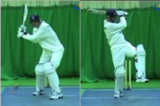
How does Ian Bell make batting look easy? Well in this drill he emphasises the importance of making sure his stance is repeatable, relaxed and straight forward.

Techniques

Inswing Bowling Grip (Right Arm)

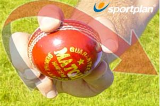
A right-arm bowler bowling to a right handed batsman will move the ball into them. The index and second finger should be placed either side of the the seam. The flat side of the thumb should be placed on the underneath of the ball. Ensure that the balls seam remains vertical and is angled towards the leg side.

Techniques

Leg Glance

1. Move both feet back towards the stumps, opening your body out towards the ball, but make sure that you keep your leg stump covered. Keep your head forward and in line with the ball. 2. Bring the bat through on as straight a path as possible, turning the bat face slightly towards the leg side and making contact with the ball in front of the front pad. 3. Control the shot with the top hand, glancing the ball away.

Techniques

Leg Spin - Grip

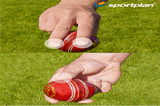
A leg spin bowler spins the ball from a right handed batsmans leg stump towards their off stump. The bowler grips the ball with the top joint of the index and middle fingers lying on the seam and the third finger bent along it. As the bowlers arm moves forward the fingers are straightened and the wrist is flicked forwards, with the palm finishing facing downwards. The 3rd finger is the one that imparts most of the spin. On release of the ball the bowler completes a full swing of the arm, driving through to the opposite hip. Its important to pivot on the ball of the front foot and make the back knee drive through the ball.

Techniques

Off Spin - Grip

The off spin moves the ball from a right handed batsmans off stump towards their leg stump. The spin is generated from the index finger, this causes the ball to alter its direction and bounce through. The ball is held by the joints of the index and middle fingers which are spread along the seam. The spin is then generated by turning the wrist in a anti-clokwise direction.

Techniques

Off Spin

Off-spin is the most popular method of spin in cricket. An off-break delivery turns from the off side to the leg side when bowled at a right-handed batsman. The spin is generated by the first and second fingers of the right hand. The more revolutions you can put on the ball, the better chance you have of getting more turn when the ball pitches.

Techniques

Overarm Throw Basic Technique

**AUDIO DESCRIPTION ON**   Standing in pairs the thrower will put their non-throwing arm across their body The throwing elbow then rests on top of their non-throwing arm Receiving player will catch the ball and repeat back to their partner

Techniques

Overarm Throw From Standing Position

**AUDIO DESCRIPTION ON** The player starts in a power position with feet aligned to target The players' front leg steps over the hurdle, ensuring it keeps pointing towards the intended target Receiving player collects the ball and repeats the drill

Techniques

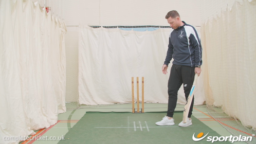
Playing with spin leg spin 1

Can be done in pairs/ groups of three. One batter, a feeder, and a wicket keeper. 4 incrediballs or cricket balls are recommended, as they have a seam to spin ball. 4 good quality feeds eachPlayer feeds from one knee, throwing ball under arm as a leg spinner, with the key being a looped feed. (If players can’t spin it, a slow looped feed is sufficient). Feeder aims to land ball on a full length, on off stump. Batter looks to play ball straight, through zone 1, to be marked out from between the stumps to cover as shown.NB – Left hander’s will still score through same zone, and should ideally be grouped together. PROGRESSION Make target area smaller, if playing to square of wicket, make target straighter.Introduce points scoring system.Bring in Zone 2 (different scoring area for length balls)Change length of feedIntroduce coming down wicket.
Techniques

Playing with spin off spin 1

Can be done in pairs/ groups of three. One batter, a feeder, and a wicket keeper. 4 incrediballs or cricket balls are recommended, as they have a seam to spin ball. 4 good quality feeds each.Player feeds from one knee, throwing ball under arm as an off spinner, with the key being a looped feed. (If players cannot spin it, a slow looped feed is sufficient). Feeder aims to land ball on a full length, and batter looks to play ball straight, through zone 1, to be marked out from between the stumps to mid wicket.NB – Left hander’s will still score through same zone, and should ideally be grouped together. PROGRESSION Make target area smaller, if playing to square of wicket, make target straighter.Introduce points scoring system.Bring in Zone 2 (different scoring area for length balls)Change length of feedIntroduce coming down wicket or sweep shot.

Techniques

Pull Shot

Can be done in pairs/ groups of three. One batter and one feeder minimum required. 6 tennis balls per pair/group. Each batter will have two rounds of 6 balls each.Feeder must feed over arm, bouncing the ball in the feeding zone, at height of feed number (1) as seen in the short ball drill.Batter plays pull shot, looking to hit ball along the ground. Nets would be essential for this practice. PROGRESSION Feeder can come closer, and feed on the full, under arm at batter for improved accuracy. This feed would also allow for rapid fire feeding, where only the hands move in the execution of the shot.Cricket balls may be used for this.

Techniques

Pull Stroke.

1. As the backswing begins, the head, shoulders and back foot move back and across. 2. The front leg is moved back and towards the leg side, forming the base for the shot with the head slightly forward. Keep the hands high and judge by the bounce and line of the ball whether or not to attempt the shot. 3. If you take on the shot then the arms should swing through and be fully extended as contact is made with the ball. 4. The follow through will either see both feet move round and point towards the path of the shot (as illustrated), or see the front leg raised off the ground, with your weight pivoting on the back foot.

Techniques

Sample drop feed

Balls is dropped on a length to batter by feeder Ball is dropped from the batters ‘off-side’ to ensure feeder safety. Ball should be a comfortable distance away from batter, and this is personal preference indicated by batter Ball is dropped from a horizontal position, arm fully stretched out, and batter looks to hit ball on the second half volley

Techniques

Swaying Away

Played to a ball that is at the body, usually rising and too high to play Hands and body are lean away from the path of ball Batter must look to go back and across stumps Maintain side on position, achieved by encouraging player to keep shoulders parallel. This keeps batter a smaller target Keep weight forward even when moving back and across, to maintain balance and control of the shot Batter must keep eye on ball all the way.

Techniques

Sweep Drill

This drill can be done in pairs/groups of three (minimum one batter and one feeder required), with six tennis balls per pair/group. Batter plays shot from one knee and progresses to ordinary stance when competent in the kneeling sweep position. The types of feed should be rapid fire feeds, where hands only move, and balls are fed quicker. Move onto the types of sweep below, hitting: Orthodox sweep Paddle sweep Slog sweep Reverse sweep Feeds need to be altered slightly here, quicker for the paddle, and wider and more looped for slog sweep.

Techniques

Technique Sheet

Open Preview

Techniques

The Long Barrier.

Approach the ball at speed and as you get into line with the ball, twist your upper body, leading with the shoulder furthest from the ball. Bend both knees, so that the knee of the leg nearest to the ball touches the ground, but it is also next to the back of the heel of the other leg. With fingers down and head forward, pick up the ball and then stand back up ready to deliver an overarm throw.

Techniques

Use of feet To Defend

Looking to defend ball after using feet coming down the wicket Quick feet from the batter are essential when getting to the ball. When advancing down the wicket, batter must aim to keep head as still as possible, and eyes level. Batter needs to be in a still position by the time they make contact, and well balanced. Encourage player to loosen bottom hand upon impact, and maintain their weight into the shot by leaning forward not back. Bat coming through straight s key, with soft hands, with player looking to drop the ball at their feet, making impact underneath their eyes.

Techniques

Use of Feet - Full follow through

Techniques

Use of feet - Off Drive

Looking to hit ball towards mid off Quick feet from the batter are essential when getting to the ball. When advancing down the wicket, batter must aim to keep head as still as possible, and eyes level. Batter needs to be in a still position by the time they make contact, and well balanced. Encourage player to loosen bottom hand upon impact, and maintain their weight into the shot by leaning forward not back. Bat following through straight s key, with a ‘checked’ follow through not full. This will help direct the ball to mid off.

Techniques