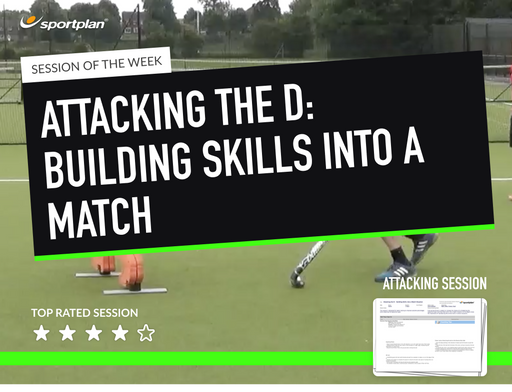
Making the right decisions when in the attacking third of the field is vital - this session works on your midfielders distribution into and around the circle. It highlights how often where the defender commits will dictate as to what type of pass they play into the circle and how the forwards lead off that accordingly.
What's in the session?
The session progresses from basic closed skills and builds upon each phase, adding in extra elements with each progression.
The initial practice develops the midfielders timing and weighting of their pass to an attacker leading across the top of the circle. The attacker then receives on their back hand, controlling the ball so that it is moving towards the baseline, not away from goal. Getting the ball moving towards the baseline makes it easier to strike the ball at goal. The focus is on the timing of the lead, timing and weight of the pass and the direction of the attackers first touch.
The next stage adds in an extra attacker at the far post who is looking for deflections. This puts emphasis on the first touch of the attacker at the top of the circle, to get it moving towards the goal to make it easier to play a good ball to the far post. The focus is also on the positioning and timing of the lead from the far post attacker.
As a progression, a defender is added into the practice where they decide whether to close down the midfielder or stay with the lead of the attacker. This will then dictate where the midfielder passes - if closed down, they play a weighted ball into space for the lead; or if the defender goes with the attacker, they play the ball directly into the circle for the other forwards to look for tip-ins. The focus is on the decision making of the midfield and leading of the attackers both at the top of the circle and those nearer the goal.
The final part puts the skills developed throughout the session into a conditioned game with small sides, working on the distribution and movement in tight areas through the middle of the pitch.

in more ways than one
 sportplan_netball



in more ways than one
sportplan_hockey

A few weeks into the league season, poor first touches are costing teams the ball. Coach body shape, scanning and receiving on the move to keep possession.

Pre-season fitness fades fast once the league starts. Build conditioning into ball work and use rolling subs well to keep your squad sharp all season.

The first weeks of the season decide whether a junior or new player sticks with adult hockey. Here is how to keep them safe, give them a clear job and build their confidence from the very first bully.