Community | Hi-5 1on1

The point guard who can only pass. The center who can only post up. The shooting guard who can only score. These specialists are increasingly obsolete. Modern basketball rewards players who can do multiple things, defend multiple positions, and fit into various lineup configurations.

The Death of Traditional Positions

Why positions are changing:

Switching defence: When teams switch all screens, every player guards every position.

Spacing demands: Five shooters on the floor requires shooting from everyone.

Playmaking: Ball handling and passing from all positions creates offensive advantages.

Matchup hunting: Versatile players can exploit whatever advantage presents itself.

Skills Every Player Needs

Regardless of size or position:

Ball handling: Every player should be able to dribble under pressure.

Shooting: Three-point range, at minimum catch and shoot, ideally off the dribble.

Passing: Court vision and the ability to make the right pass.

Defence: Ability to guard on the perimeter and in the post.

Basketball IQ: Understanding spacing, timing, and team concepts.

Developing Bigs

Traditional big man skills aren't enough:

Perimeter shooting: Stretch fours and fives who can shoot threes.

Ball handling: Attacking closeouts, making plays in short roll situations.

Passing: Playmaking from the post or high post.

Perimeter defence: Ability to switch onto guards and close out on shooters.

Developing Guards

Small players need post skills too:

Post defence: Technique to compete against bigger players when switched.

Rebounding: Boxing out and pursuing despite size disadvantage.

Post offense: Taking advantage of smaller defenders.

Physicality: Strength to absorb contact at both ends.

Youth Development Implications

How this affects coaching young players:

Don't specialize early: Let kids play multiple positions.

Skill development for all: Every player works on handles, shooting, and passing.

Size doesn't determine role: Tall kids need guard skills. Small kids need post skills.

Movement over size: Athletic, mobile players are more valuable than just big players.

Team Implications

Lineup flexibility: Versatile rosters can adjust to any matchup.

Defensive switching: Everyone can guard everyone without exploitable weak links.

Offensive flow: Any player can make plays, creating unpredictability.

Key Coaching Points

  • Traditional positions are increasingly obsolete
  • All players need ball handling, shooting, passing, and defensive versatility
  • Bigs must develop perimeter skills; guards must develop post skills
  • Youth development should avoid early position specialization
  • Versatile rosters create strategic flexibility
Drills for Versatile Development

VIEW ALL BASKETBALL DRILLS

JOIN SPORTPLAN FOR FREE

  • search our library of 650+ basketball drills
  • create your own professional coaching plans
  • or access our tried and tested plans
Michalis Coach, Cyprus

DESCRIPTION

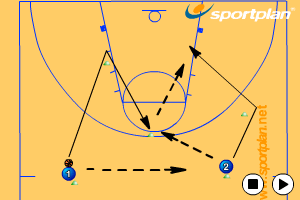
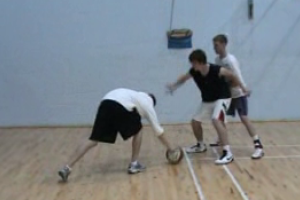
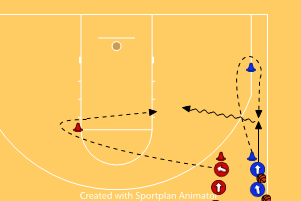
This is a really good competitive drill to improve ballhandling, 1 on 1 moves in the open court, close outs, and 1 on 1 defense. The "high five" in the middle adds a fun element to the drill and requires player to dribble

COACHING POINTS

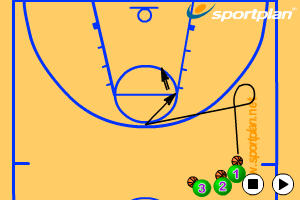
Instructions: Two groups of players out of bounds, free throw line extended. Each player in group 1 (attackers) has a ball. Group 2 players (defenders) are on the opposite side. Players 1 and 2 step in. Player 1 starts dribbling while player 2 starts running. They meet at the free throw spot where they exchange a "high five". Player 1 changes direction and dribbles fast to half court, he touches the midcourt line and attacks the basket. Player 2 runs under the basket and closes out defending against the advancing dribbler. 1 on 1 follows. Both players can rebound a missed shot and shoot again to a score (at the same basket). When a basket has been made or when a given number of shots (2 or 3) have been taken, players switch groups and roles. Teaching Tips: The defensive player must play aggressively: Rush at the ball handler (never wait for him in the paint). Stop quickly so the attacker can't beat you. Contest any shots (including three pointers) and any drives to the basket. Work on proper defensive stance and footwork. Pay attention to the offensive player’s strong side. The attacker has to create an advantage for himself (using dribble moves, hesitations and so on), trying to take an open shot or an easy drive to the basket. Don’t stop! The attacker should make a move immediately and take advantage of the space they have in the open court. Get the defender on their heals and beat them right or left. A quick inside-out dribble move or quick change of direction attacking the defender's top foot should allow the attacker to maintain momentum to the basket. Box out after any shots and fight for the rebound. Variations: Make it more competitive: the “losing” player always goes (or remains) in the defensive players’ group. Set a time limit for every action.

This practice has no coaching points

PROGRESSION

This practice has no progressions

READ MORE
READ LESS

JOIN SPORTPLAN FOR FREE

  • search our library of 650+ Basketball drills
  • create your own professional coaching plans
  • or access our tried and tested plans

JOIN SPORTPLAN FOR FREE

  • search our library of 650+ basketball drills
  • create your own professional coaching plans
  • or access our tried and tested plans
;

Sportplan App

Give it a try - it's better in the app

X
YOUR SESSION IS STARTING SOON... Join the growing community of basketball coaches plus 650+ drills and pro tools to make coaching easy.
LET'S DO IT