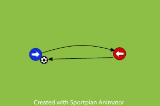
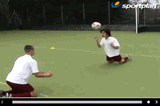
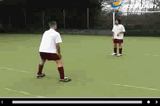
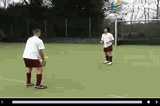
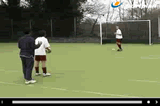
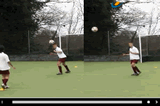
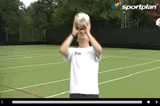
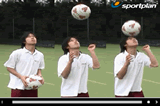
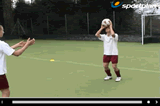
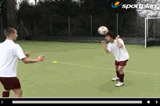
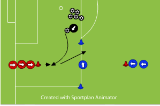
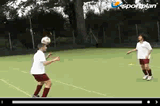
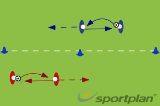
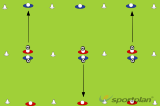
Standing in pairs opposite each other the feeder throws the ball for their partner. The receiving player then heads the ball back into the feeder's hands.
Heading
Both players start on their knees with one player feeding an accurate throw for the other player to attack. It is best to begin practising this drill on knees and progress to the standing up position when players feel more confident.
One feeder throws the ball up for the other player to try and head, back between the feeder's legs. The feeder needs to stand with their feet apart and react quickly to the return header. The heading player should keep their feet moving, being ready at all times to head the ball back with power.
Group in pairs. 1 ball per pair. Repeat in 5 other areas for a total of 12 players. The goalkeeper serves the ball underhand and with both hands in front of the player. The player runs in and heads the ball towards the goal. He should look up and head the ball downwards and towards the corners. Rotate positions. Serve the ball high or low to encourage the player to dive or leap to meet the ball.
A progression from the attacking header drill. The jump adds extra power and purchase to the header and means the player can meet the ball in the air earlier that if they didn't jump.
Defensive header relay. 3 players with one ball. Front player of the 2 players throws up the ball to the heading player, after the player throws the ball he has to try and close down the heading player. The player heading the ball has to head the ball over the approaching player to the 3rd player waiting to catch the ball.
One player throws the ball to the other player's head. The throw should be slightly in front of the heading player so that they need to meet the ball in the air. The returning header should also be slightly long, meaning the catching player needs to back track slightly in order to catch the ball.
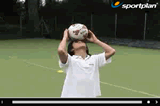
One ball per player. Players must place the ball above their brow on their foreheads and try to balance it there for as long as possible.
One ball per player. Players hold the ball slightly above their foreheads and then release it for one mini header, back into their hands which are still above their head. Repeat.
One ball per player. Players hold the ball at shoulder height and then gently throw it just above their foreheads two mini headers in a row. Players then catch the ball above their heads and repeat.
Players throw the ball up for themselves and head the ball lightly into the air once and catch the ball again. Repeat.
1 ball between two players. One player feeds the ball, throwing a looping throw for them to head. The other player catches the ball just in front of their forehead as they are about to head the ball, bending their knees slightly as they do before throwing the ball back.
1 ball between two players. One player feeds the ball using a looping throw to their partner's head. The receiving player heads the ball back into the other player's hands who then catches the ball.
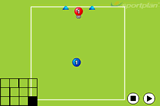
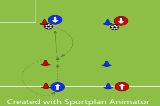
Players are split into two teams and line up behind the red cone at their end. One blue player starts in the middle between the two middle cones. They are the goalkeeper. To start the drill the coach feeds a lofted throw to the red player to advance onto and try to head between the cones. The blue keeper tries to stop the ball and can use any part of their body to do so. After they have headed the ball the goalkeeping player joins the back of the opposite line and the red player (who just had the attacking header) becomes the new keeper between the cones.
two players tryto head the ball to each other as may times as possible.
1 ball between two players. One player feeds and catches the ball, while the other player heads the ball back to the player throwing. The player must head the ball back to the feeder's hands. However, both players should be moving at all times - firstly the feeder should walk forwards, but when they reach the baseline players change direction.
The player with the ball feeds it anti-clockwise to the second player's head for them to head to the third player in the triangle. The third player now feeds the ball to the first player for them to head to the second player's hands.
Objective: To get a basic understanding of heading the ball. Detail: Players work in pairs to begin with, so 8 x 2. I player acts as a server, whilst the other player heads the ball back. To progress, players head the ball to their partner and run around them and back to original position.
Working in pairs one player feeds whilst the other player is the returning player who heads the ball back to the feeder's hands. However, the returning player must have their wits about them as they need to listen out to the feeder's call. The feeder has three calls - Feet, attacking and defensive. Depending on the call the heading player must perform a different sort of header.
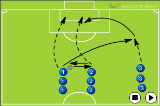
Players line up in 3 queues, with the ball starting with player 1. Player 1 makes a 1-2 pass with player 2 before passing the ball down the line for player 3 to run onto. Player 3 times their run to meet the pass and gets the ball under control before swinging a cross into the box for the players 1 and 2 to run onto and head into the goal.