Pre-season field based conditioning and movement training for rugby union

May 2026

Kicking from hand is at record levels in elite rugby. Six Nations 2026 was the most kicked-from-hand championship since stats began, and the same trend is showing across the URC, Champions Cup and Super Rugby. Coaches have realised that good kicks force opponents into pressured returns - and pressured returns are the easiest scoring opportunities in the game.

The flip side is just as important. If your side is on the receiving end of all those kicks, your counter-attack is no longer a luxury skill - it is a core part of your attacking game plan. The most exciting tries in 2026 are not coming from set-piece strike moves. They are coming from broken-field returns.

Why the Counter-Attack Has Become Central

When a team kicks, three things happen at once. Their forwards are spread across the field as chasers rather than packed around the ball. Their defensive line is in motion, not set. And the receiving team has the ball with space in front of them. Combined, those three factors mean the defence is at its most vulnerable in the seconds immediately after a kick.

Modern attacking analysts call this the "transition window". It typically lasts six to eight seconds. If the receiving team can move the ball into space inside that window, they create a numerical or positional advantage that no structured attack could engineer in open play.

The Three Decisions Every Receiver Must Make

Catching the ball is the easy part. The decision that follows is what separates good counter-attacking teams from poor ones. Train your back three to run through three questions every time they collect a kick.

Decision 1 - Time and space: How close is the nearest chaser? If a chaser is within five metres and closing fast, the answer is almost always to return the kick. If the nearest chaser is ten metres away or more, the carry is on.

Decision 2 - Width on the field: Where are my support runners? A counter-attack needs at least two players in support. If the wingers are still on their wings and the full-back caught it, there is no point trying to run - the carrier will be isolated. Better to step infield to a phase, then launch the next play.

Decision 3 - The defensive picture: Which side is undermanned? Most chase lines come up flat and even, but there is almost always a weakness - usually on the far side of the field where the original kicker stayed back. Counter to that space, not into the strongest chase channel.

How to Build Counter-Attack Habits

Counter-attacking cannot be taught from a whiteboard. It is a reactive skill and must be trained in environments that look like the game. Here is a progression that works at every level from U16 upward.

Stage 1 - Catch and scan: Two minutes of high-ball drills where every catcher must shout the position of the nearest chaser before they hit the ground. This trains the pre-catch scan, which is the foundation of every good counter-attack.

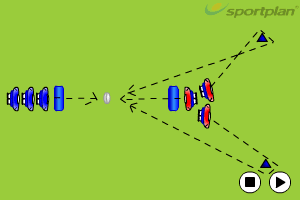
Stage 2 - 3v2 from a kick: Coach kicks the ball into a back three. Two chasers come from 20 metres. The back three must keep the ball alive and beat the chasers using one of three responses: switch infield, hit a support runner on the outside, or counter-kick.

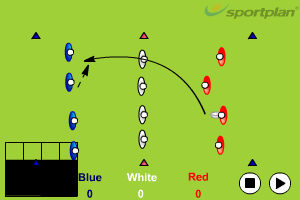
Stage 3 - Full-pitch transition game: Conditioned game where every kick must be returned. No mark allowed, no exit kick allowed. Forces players to find solutions and exposes which units have not learned to support the back three quickly.

The Forwards' Role in Counter-Attack

This is where most teams fail. The back three can be brilliant, but if the forwards are still standing where they were before the kick, the counter dies at the first ruck. Coach your forwards to react to opposition kicks like a fire alarm - the closest three drop into the back-field as immediate support, while the rest fan out across the pitch ready to play.

This habit takes weeks to embed. Start by freezing training every time a kick is fielded and asking each forward to show where they should be running. Repetition turns it from a thought into a reflex.

Key Coaching Points

  • The transition window is six to eight seconds - move the ball before it closes
  • Train the pre-catch scan: who is chasing, how close are they, where is the space?
  • Counter to the weak side of the chase, not into the strongest channel
  • Forwards must react to kicks as quickly as the back three
  • Avoid contact in your own 22 - if the counter is not on, return the kick

Recommended Drills

VIEW ALL DECISION-MAKING DRILLS

Paul Joyce Coach, England

DESCRIPTION

Outline for a simple but effective preseason conditioning programme, speed and C.O.D training.

COACHING POINTS

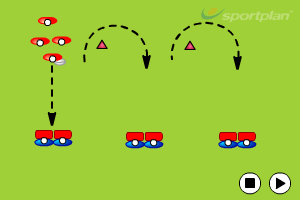
Testing 300m shuttle test Aim: To monitor player’s intermediate anaerobic power. Set up: place two lines of cones 25m apart. Performing the test: Complete twelve continuous shuttles (300m) as fast as possible. Record time they completed the run in. Give them 5 minutes recovery (no more, no less). Repeat step 1 and step 2. End test. (Note: This test is a standard test, do not change the test in anyway) Benefits Easy to administer Easily repeatable Provides clear indicators to a players fitness levels and their improvements in between tests. Data Mean time (add both times together and divide by 2) Fatigue index – the drop between both runs (time difference between the 2 runs) Standards we should be aiming for; Backs mean score = 50 +/-5 sec Forwards mean score = 60 +/- 5 sec Conditioning drills Tempo runs Aim: Developing baseline sprint related conditioning (Tempo runs are neither sprinting nor jogging).To reintroduce high speed running with reduced risk of injury from muscular strains which can occur during aggressive acceleration, deceleration, and if someone is returning to top speed sprinting after a period away from performing them. Set up: Open space to perform straight line runs. In this example, I am using half the length of a rugby pitch, although the distance is can be as much as 150m or as little as 30m (performing a shuttle tempo run). Performance: The athlete will stride the length of the course, walk back and repeat. A stride is the middle ground between jogging and sprinting. Have the athlete perform a set distance and only measure the runs, not the recovery walks. Coaching points: Be sure that the athlete is striding so that they are developing the full running mechanics (hip hyperextension) at a lower intensity than a full sprint would require. 150m & 300m Shuttle runs Aim: Improve speed endurance with multiple accelerations and decelerations. Set up: place two lines of cones 25m apart. Performance 150m shuttle: Complete six continuous shuttles (150m) as fast as possible. Performance 300m shuttle: Complete twelve continuous shuttles (300m) as fast as possible. Coaching points: Use good acceleration mechanics to begin drill (Centre of mass ahead of base of support, powerful leg drive, low recovery leg mechanics, aggressive arm drive, and running on the balls of feet). Use good linear top speed mechanics mid run. As the athlete reaches the cone, the centre of mass should be lowered and stride should be shortened. When changing direction, the hips need to be turned around 90o, and the cutting foot needs to be planted wider than the hips and knees. When changing direction, the foot should be planted in a range that is in between pointing the direction you were moving, and the direction in which you wish to move, although the foot being at either of these extremes is sub-optimal and may increase the risk of ankle injury. (No two-foot plants will ever be the same, so do not try to over coach this). When changing direction, the foot should land almost flat footed, but with the weight towards the ball of the foot, which will allow for a greater force to be applied. The body weight should stay within the base of support, enabling an effective line of force to be maintained. The athlete should attain and maintain effective positive angles at the ankle knee and hip. The athlete should use an effective acceleration action. Preseason conditioning outline Wk 1:300m SHUTTLE TESTS Wk 1 – 3: Tempo runs x 10 – 12 – 14 (500m, 600m, 700m) Wk 4: (D1) 4 x 150m shuttle <30s, 60s recovery (600m). (D2) Tempo runs x 14 Wk 5: (D1) Tempo runs x 14. (D2) 5 x 150m shuttle <30s, 60s recovery (750m) Wk 6: (D1) 6 x 150m shuttle <30s, 60s recovery (900m). (D2) Tempo runs x 14 Wk 7: (D1) 1 x 300m shuttle <60s, 3 x 150m shuttle <30s, 60s recovery (750m). (D2) Tempo runs x 14 Wk 8: (D1) Tempo runs x 14. (D2) 1 x 300m shuttle <60s, 4 x 150m shuttle <30s, 60s recovery (900m) Wk 9: (D1) 2 x 300m shuttle <60s, 3 x 150m shuttle <30s, 60s recovery (1050m). (D2) Tempo runs x 14 Wk 10: (D1) 300m SHUTTLE TESTS (D2) Tempo runs x 7 (Note: Perform tempo runs at the end of the session. Perform shuttles at the beginning of the session after a thorough warm-up) Speed and Change of Direction drills Incremental acceleration runs Aim: To develop acceleration speed in a controlled manner whilst minimising the risk of injury after an extended period away from performing/training. Set up: Set up five cones in a line, the first four being 5m apart from the previous. Place the fifth cone 15m beyond the fourth cone. The total distance from the first cone to the final cone should be 30m. Performance: The athlete starts at the first cone and accelerates to a designated cone. Once they reach that cone, they maintain the speed they have reached until they pass the final cone at which point they begin to slow down in a controlled manner. Coaching points: Use good acceleration mechanics to begin drill (Centre of mass ahead of base of support, powerful leg drive, low recovery leg mechanics, aggressive arm drive, and running on the balls of feet). Use good linear top speed mechanics once they reach the desired speed. Do not allow the athlete to stop suddenly once they reach the final cone, have them slow down in a controlled manner. In and out runs Aim: Improve ability to change direction without loss of speed/acceleration. Set up: Place cones in a 5x3 grid with 5m distance in between each. Performance: Using one line of five cones; use an effective running action to run in and out of each cone to the end. At each cone increase speed until at maximum speed upon reaching the final section and maintains until the end of the course. Coaching points: Athlete must maintain an upright posture or a slight forward lean. The athlete must be coached to not allow the hips to sink on contact. The inside foot will contact the ground directly in-line with the centre of mass or slightly across the centre line creating a small ‘crossover step’. Foot contacts should be on the balls of the feet. Eyes should be looking forward, not down at feet. Curve runs Aim: Improve ability to change direction without loss of speed. Set up: Place cones in a 5x3 grid with 5m distance in between each. Performance: Using all fifteen cones; start on one corner and complete a single arced run around either the middle cone of the middle line or middle cone of furthest line and finishing at the end cone of the line you began on. This should be performed whilst athlete is continuously accelerating up to top speed. Once athlete has completed desired number of repetitions from one side, they must repeat from the opposite side. Coaching points: Athlete must maintain an upright posture or a slight forward lean. The athlete must be coached to not allow the hips to sink on contact. The inside foot will contact the ground slightly across the centre line and under the centre of mass creating a small ‘crossover step’. Foot contacts should be on the balls of the feet. Eyes should be looking forward, not down at feet. Cut step runs Aim: Develop and improve and athletes ability to change direction when a rapid deceleration and then acceleration is required, using a ‘cut step’. Set up: Place cones in a 5x3 grid with 5m distance in between each. Performance: The athlete begins the drill at one of the bottom corners. The athlete accelerates towards the middle cone on the next line up, at which point they will aggressively decelerate and perform a cut step and head back out towards the outside cone on the third row. The athlete will repeat this action, zig-zagging, all the way to the other end of the course, performing a cut step at each cone. To change the angle of the cut step and distance for them to accelerate, have the athlete zig-zag between both outside line of cones. Note: This drill can be used with pairs or small groups. Have them start at opposite corners and stagger their starts to avoid collisions in the middle. Coaching points: The athlete must accelerate towards the first cone using good acceleration mechanics (centre of mass ahead of base of support, powerful leg drive with low recovery leg mechanics, aggressive arm drive, and running on the balls of the feet). As the athlete reaches the cone, the centre of mass should be lowered and stride should be shortened. When changing direction the cutting foot needs to be planted wider than the hips and knees. When changing direction the foot should be planted in a range that is in between pointing the direction you were moving, and the direction in which you wish to move, although the foot being at either of these extremes is sub-optimal and may increase the risk of ankle injury. (No two foot plants will ever be the same, so do not try to over coach this). When changing direction the foot should land almost flat footed, but with the weight towards the ball of the foot, which will allow for a greater force to be applied. The body weight should stay within the base of support, enabling an effective line of force to be maintained. The athlete should attain and maintain effective positive angles at the ankle knee and hip. The athlete should use an effective acceleration action. Preseason Speed and Change of Direction training outline Wk 1 – 4: Wk 5: (D1) 4 x in and outs, 4 x curved runs (change run each time). (D2) 1 x incremental acceleration runs Wk 6: (D1) 2 x incremental acceleration runs. (D2) 6 x in and outs, 8 x curved runs (change run each time) Wk 7: (D1) 8 x in and outs, 8 x curved runs (change run each time). (D2) 3 x incremental acceleration runs Wk 8: (D1) 3 x incremental acceleration runs. (D2) 8 x in and outs, 8 x curved runs (change run each time) Wk 9: (D1) 4 x in and outs, 4 x curved runs (change run each time), 4 x cut step runs (2 x narrow, 2 x wide). (D2) 3 x incremental acceleration runs Wk 10:(D1) 300m SHUTTLE TESTS. (D2) 4 x in and outs, 4 x curved runs (change run each time), 4 x cut step runs (2 x narrow, 2 x wide). References Jeffreys, I. (2010). Gamespeed: movement training for superior sports performance. Monterey: Coaches Choice Boyle, M. (2017). New Functional Training for sports 2nd Edition. ebook: Human Kinetics

This practice has no coaching points

PROGRESSION

This practice has no progressions

READ MORE
READ LESS

JOIN SPORTPLAN FOR FREE

  • search our library of 1100+ Rugby drills
  • create your own professional coaching plans
  • or access our tried and tested plans

JOIN SPORTPLAN FOR FREE

  • search our library of 1100+ rugby drills
  • create your own professional coaching plans
  • or access our tried and tested plans
;

Sportplan App

Give it a try - it's better in the app

X
YOUR SESSION IS STARTING SOON... Join the growing community of rugby coaches plus 1100+ drills and pro tools to make coaching easy.
LET'S DO IT