Community | fast break defense 2

Traditional tennis coaching follows a familiar pattern: the coach demonstrates the "correct" technique, the player attempts to copy it, the coach provides feedback on deviations from the model. This approach produces technically proficient players - but often players who struggle to adapt when things don't go according to plan.

Ecological dynamics offers a different approach: rather than prescribing technique, coaches design environments that guide players to discover solutions themselves.

What is Ecological Dynamics?

The theoretical foundations:

Movement emerges from constraints: Movement patterns aren't pre-programmed but emerge from the interaction between the player, the task, and the environment.

Variability is valuable: Traditional coaching sees variability as error to be eliminated. Ecological dynamics sees it as exploration that leads to adaptable skill.

Representative design: Practice should represent competition. Drills that remove decision-making remove the most important element.

Perception-action coupling: Technique and decision-making shouldn't be separated. Players need to practice reading the game while executing skills.

Constraints-Led Coaching

Coaches manipulate three types of constraints:

Task constraints: Rules of the game, equipment, targets. Examples: play only with topspin, hit to the backhand side, rally must include a drop shot.

Environmental constraints: Court surface, weather, opponent behaviour. Examples: practice on different surfaces, add wind, use different ball speeds.

Individual constraints: Player's physical capabilities, experience, psychological state. Examples: handicap stronger players, adjust court size for ability.

Practical Applications

How to apply ecological dynamics in tennis:

Games-based practice: Replace isolated drilling with modified games. Players learn to serve by playing games where serving matters, not by hitting into an empty service box.

Target manipulation: Instead of telling players where to aim, create targets that guide them there. Scoring zones encourage certain patterns without explicit instruction.

Equipment modification: Slower balls, smaller courts, different rackets. These constraints guide technique without prescribing it.

Opponent variation: Practice against different styles of players. Each opponent presents different problems to solve.

Discovery Learning

The coach's role changes from prescriber to designer:

Ask, don't tell: Instead of "bend your knees more," ask "what happens if you get lower?" Let players discover the relationship.

Problem presentation: Present problems for players to solve. "Your opponent keeps lobbing you - what could you try?"

Attention direction: Guide attention to relevant information rather than prescribing solutions. "Watch where they're standing before you hit."

Allow exploration: Players need freedom to try different solutions, including unsuccessful ones.

Benefits of the Approach

Adaptability: Players who have explored solutions transfer better to new situations. Match play is never exactly like practice.

Creativity: Players develop unique solutions suited to their bodies and games, not copies of a model technique.

Engagement: Games and problem-solving are more engaging than repetitive drilling. Players practice longer and with more focus.

Retention: Self-discovered solutions are better retained than prescribed techniques.

Challenges and Limitations

Ecological dynamics isn't a complete rejection of traditional coaching:

Time requirements: Discovery learning can take longer than direct instruction for basic skills.

Coach expertise: Designing effective constraints requires deep understanding of the game and skill development.

Player frustration: Some players prefer being told what to do. Managing frustration during exploration is important.

Balance needed: Most coaches blend approaches - some direct instruction with discovery learning.

Designing Practice Sessions

Principles for constraints-led session design:

Start with the game: What do you want players to be able to do in matches? Work backward from there.

Add context: Even technique work should include decision-making elements.

Vary conditions: Don't let players groove one pattern. Change something regularly.

Reflect and discuss: Ask players what they noticed, what worked, what they might try next.

Key Coaching Points

  • Movement emerges from constraints - design the environment, not just the technique
  • Variability in practice creates adaptable players
  • Games and problem-solving develop decision-making alongside technique
  • Ask questions rather than giving answers - guide discovery
  • Balance exploration with direct instruction based on player needs

Drills for Adaptable Development

VIEW ALL GAMES-BASED DRILLS

JOIN SPORTPLAN FOR FREE

  • search our library of 1200+ handball drills
  • create your own professional coaching plans
  • or access our tried and tested plans

DESCRIPTION

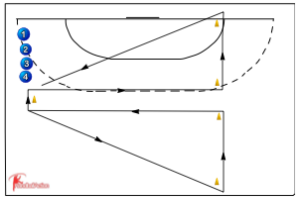
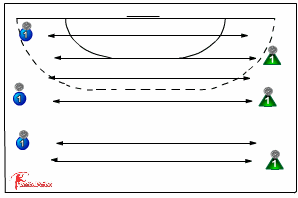
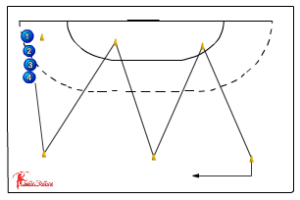
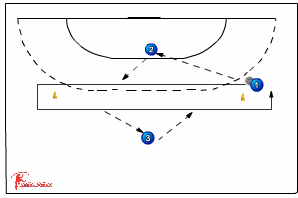
Feeder A passes to B, B starts forward and is tackled by the defender F, then passes to C who throws at the goal. During the shot, feeder E passes to player D, defender F tries to intercept the long pass from E-D. Players F and B change places. Return balls to the feeders A and D.

COACHING POINTS

Focuss on straight fast passes.Feeder E must also throw a straight pass, giving defender F the opportunity to intercept the pass.

This practice has no coaching points

PROGRESSION

This practice has no progressions

READ MORE
READ LESS

JOIN SPORTPLAN FOR FREE

  • search our library of 1200+ Handball drills
  • create your own professional coaching plans
  • or access our tried and tested plans

JOIN SPORTPLAN FOR FREE

  • search our library of 1200+ handball drills
  • create your own professional coaching plans
  • or access our tried and tested plans
;
Handball COMMUNITY DRILLS
Seniors 16+warming upAttackingCenter shotCenter shot when runningCenter shot hip heightJump shot highJump shot farDiving and shootingPassing varieties/catching-passingPass/shot feinting(dummy)Feinting (Dummy) with ballBallcirculationCrossingChanging positionsScreeningAttacking against man-to-man defencePosition play 3:3Position play 2:4Concept play : going to 2:4Concept play : tricksFast breakAttacking in powerplay situationsAttack : free throwsDefendingDefenders movementsBlockingDefence when attackers catch the ball/shoot/passDefence of dribblingClose defence for attackerBlocking ball and attacker"s waysDefence : keeping formation/helping ou/preventing break throughCooperation in defenceDouble blockingDefence : man-to-man3:2:1 defence5:1 defence6:0 defenceFitnessPower training : jumpingPower training : throwingFlexibilitySpeedEnduranceCoordinationExtrasHandball GamesComplex shooting exercisesShooting wing playerShooting pivotShooting Back Court Playersmall match playingIntermediate 13-15warming upAttackingCenter shotCenter shot when runningCenter shot hip heightJump shot highJump shot farDiving and shootingPassing varieties/catching-passingPass/shot feinting(dummy)Feinting (Dummy) with ballBallcirculationCrossingChanging positionsScreeningPosition play 3:3Fast breakAttacking in powerplay situationsAttack : free throwsDefendingDefenders movementsBlockingDefence when attackers catch the ball/shoot/passDefence of dribblingClose defence for attackerBlocking ball and attacker"s waysDefence : keeping formation/helping ou/preventing break throughCooperation in defenceDouble blockingAttacking against man-to-man defence3:2:1 defence5:1 defenceYouth 10 - 12 Yearswarming upShooting/defend shootingDribbling/defence of dribblingSupporting team mates/ blocking attackersAttackingCenter shotCenter shot when runningCenter shot hip heightJump shot highJump shot farDiving and shootingPassing varieties/catching-passingPass/shot feinting(dummy)Feinting (Dummy) with ballDefendingDefenders movementsBlockingDefence when attackers catch the ball/shoot/passDefence of dribblingClose defence for attackerBlocking ball and attacker"s waysJunior 8 - 9 YearsStability/balanceRunning/jumping/movingFalling-rollingPulling-pushingAiming/throwingBallskill activitiesPassing/intercepting + finding space and defendingShooting/defend shootingDribbling/defence of dribblingSupporting team mates/ blocking attackersMini 6 - 7 YearsStability/balanceRunning/jumping/movingFalling-rollingPulling-pushingAiming/throwingBallskill activitiesPassing/intercepting + finding space and defendingGoalkeepersGoal keeper : reaction exercisesGoal keeper : flexibilityGoal keeper : power exercisesGoal keeper : fast breakGoal keeper : exercises
Handball DRILL CATEGORIES
Seniors 16+warming upAttackingCenter shotCenter shot when runningCenter shot hip heightJump shot highJump shot farDiving and shootingPassing varieties/catching-passingPass/shot feinting(dummy)Feinting (Dummy) with ballBallcirculationCrossingChanging positionsScreeningAttacking against man-to-man defencePosition play 3:3Position play 2:4Concept play : going to 2:4Concept play : tricksFast breakAttacking in powerplay situationsAttack : free throwsDefendingDefenders movementsBlockingDefence when attackers catch the ball/shoot/passDefence of dribblingClose defence for attackerBlocking ball and attacker's waysDefence : keeping formation/helping ou/preventing break throughCooperation in defenceDouble blockingDefence : man-to-man3:2:1 defence5:1 defence6:0 defenceFitnessPower training : jumpingPower training : throwingFlexibilitySpeedEnduranceCoordinationExtrasHandball GamesComplex shooting exercisesShooting wing playerShooting pivotShooting Back Court Playersmall match playingIntermediate 13-15warming upAttackingCenter shotCenter shot when runningCenter shot hip heightJump shot highJump shot farDiving and shootingPassing varieties/catching-passingPass/shot feinting(dummy)Feinting (Dummy) with ballBallcirculationCrossingChanging positionsScreeningPosition play 3:3Fast breakAttacking in powerplay situationsAttack : free throwsDefendingDefenders movementsBlockingDefence when attackers catch the ball/shoot/passDefence of dribblingClose defence for attackerBlocking ball and attacker's waysDefence : keeping formation/helping ou/preventing break throughCooperation in defenceDouble blockingAttacking against man-to-man defence3:2:1 defence5:1 defenceYouth 10 - 12 Yearswarming upShooting/defend shootingDribbling/defence of dribblingSupporting team mates/ blocking attackersAttackingCenter shotCenter shot when runningCenter shot hip heightJump shot highJump shot farDiving and shootingPassing varieties/catching-passingPass/shot feinting(dummy)Feinting (Dummy) with ballDefendingDefenders movementsBlockingDefence when attackers catch the ball/shoot/passDefence of dribblingClose defence for attackerBlocking ball and attacker's waysJunior 8 - 9 YearsStability/balanceRunning/jumping/movingFalling-rollingPulling-pushingAiming/throwingBallskill activitiesPassing/intercepting + finding space and defendingShooting/defend shootingDribbling/defence of dribblingSupporting team mates/ blocking attackersMini 6 - 7 YearsStability/balanceRunning/jumping/movingFalling-rollingPulling-pushingAiming/throwingBallskill activitiesPassing/intercepting + finding space and defendingGoalkeepersGoal keeper : reaction exercisesGoal keeper : flexibilityGoal keeper : power exercisesGoal keeper : fast breakGoal keeper : exercises

Sportplan App

Give it a try - it's better in the app

X
Handball POPULAR SEARCH TERMS
YOUR SESSION IS STARTING SOON... Join the growing community of handball coaches plus 1200+ drills and pro tools to make coaching easy.
LET'S DO IT