Community | Form shooting

The point guard who can only pass. The center who can only post up. The shooting guard who can only score. These specialists are increasingly obsolete. Modern basketball rewards players who can do multiple things, defend multiple positions, and fit into various lineup configurations.

The Death of Traditional Positions

Why positions are changing:

Switching defence: When teams switch all screens, every player guards every position.

Spacing demands: Five shooters on the floor requires shooting from everyone.

Playmaking: Ball handling and passing from all positions creates offensive advantages.

Matchup hunting: Versatile players can exploit whatever advantage presents itself.

Skills Every Player Needs

Regardless of size or position:

Ball handling: Every player should be able to dribble under pressure.

Shooting: Three-point range, at minimum catch and shoot, ideally off the dribble.

Passing: Court vision and the ability to make the right pass.

Defence: Ability to guard on the perimeter and in the post.

Basketball IQ: Understanding spacing, timing, and team concepts.

Developing Bigs

Traditional big man skills aren't enough:

Perimeter shooting: Stretch fours and fives who can shoot threes.

Ball handling: Attacking closeouts, making plays in short roll situations.

Passing: Playmaking from the post or high post.

Perimeter defence: Ability to switch onto guards and close out on shooters.

Developing Guards

Small players need post skills too:

Post defence: Technique to compete against bigger players when switched.

Rebounding: Boxing out and pursuing despite size disadvantage.

Post offense: Taking advantage of smaller defenders.

Physicality: Strength to absorb contact at both ends.

Youth Development Implications

How this affects coaching young players:

Don't specialize early: Let kids play multiple positions.

Skill development for all: Every player works on handles, shooting, and passing.

Size doesn't determine role: Tall kids need guard skills. Small kids need post skills.

Movement over size: Athletic, mobile players are more valuable than just big players.

Team Implications

Lineup flexibility: Versatile rosters can adjust to any matchup.

Defensive switching: Everyone can guard everyone without exploitable weak links.

Offensive flow: Any player can make plays, creating unpredictability.

Key Coaching Points

  • Traditional positions are increasingly obsolete
  • All players need ball handling, shooting, passing, and defensive versatility
  • Bigs must develop perimeter skills; guards must develop post skills
  • Youth development should avoid early position specialization
  • Versatile rosters create strategic flexibility
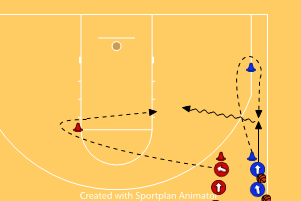
Drills for Versatile Development

VIEW ALL BASKETBALL DRILLS

JOIN SPORTPLAN FOR FREE

  • search our library of 650+ basketball drills
  • create your own professional coaching plans
  • or access our tried and tested plans
Antonio Rodrigues Coach, Cape Verde

DESCRIPTION

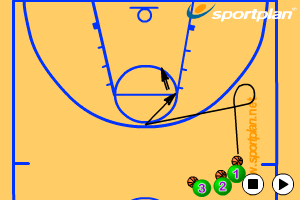
Each player needs to grab a basketball and find a basket. It works best to have three players (or less) at each basket. Two players on each side of the basket and one in front. Each player should stand about 2 feet from the basket. (Yes, it's only two feet. Do not stand farther back!) For right handed shooters, your right foot should be centered with the basket and pointing directly towards the middle of the basket. Your left foot should be positioned shoulder width apart in a comfortable position. Most players leave their left foot slightly behind the other foot. The left foot should be pointing in the relative area of the basket but probably should not be pointing directly at it. Most players feel the most comfortable with their left foot pointing just to the left of the basket. Bend your knees, at a comfortable angle somewhere around 45 degrees. Now if you're feet are aligned properly, the rest of your body should follow suit. Hold the ball in your hand, palm facing up. Your non-shooting hand can dangle to the side. Slowly bring the ball in and hold is as if you were shooting with one hand. Your arm should form a 90 degree angle. Your tricep should be parallel with the floor and directly above your right leg. Your wrist should be bent with fingers spread out. The ball should be sitting on your finger pads, NOT your finger tips. Your index finger should be in the center of the ball. Pause. This is when you make sure your arm, feet, and everything is in the correct form. Look at the front of the rim. Proceed to shoot with one hand, leaving your off hand to the side. The player should use his legs on every shot. At the end of the shot, the player should be up on his toes. This is very important, because players generate most of their strength from their legs to shoot the ball to the basket. Hold your follow through. Tell your players, "It's like reaching into a cookie jar." Grab the ball and repeat the process. Get the ball quickly but don't hurry your shot! Take your time. Each player should get a minimum of 20 repetitions, but 50 or 100 would be better. As players master this skill, you can progress to other variations: Use two hands instead of one. Just make sure the off hand is one the side of the ball and not used to propel the ball. Do a jump shot. You should still stay two feet from the basket. Flip the ball to yourself, pivot, and shoot a jump shot. Again, stay close to the basket and make sure you proper form, even though you are going slightly faster. Do not sacrifice form! For more advanced players, we commonly start with one-hand form shooting and progress all the way to pivots. We generally spend a few minutes on each progression and check all the players to make sure their form is not slipping.

COACHING POINTS

Points of Emphasis Continually tell your players... - Hold your follow through. - Take your time and always make sure your form is perfect. - Bend your knees. - Don't stand back too far! Stay just a couple feet from the basket. Motivation / Teaching Tips Tip #1 - Tell you players, "Once you get good at it, don't think you can stop. There are NBA players that do form shooting everyday!" Tip #2 - Assign a coach to each basket to make sure they are using proper form. Help them correct any problems. If they don't do it properly, this drill is a waste of time. Tip #3 - Make sure your players do NOT dip one shoulder or lean too far forward. When shooting, you want your players to have an erect torso. I like to use the phrase "shoot tall." Source: https://www.breakthroughbasketball.com/drills/formshooting.html

This practice has no coaching points

PROGRESSION

This practice has no progressions

READ MORE
READ LESS

JOIN SPORTPLAN FOR FREE

  • search our library of 650+ Basketball drills
  • create your own professional coaching plans
  • or access our tried and tested plans

JOIN SPORTPLAN FOR FREE

  • search our library of 650+ basketball drills
  • create your own professional coaching plans
  • or access our tried and tested plans
;

Sportplan App

Give it a try - it's better in the app

X
YOUR SESSION IS STARTING SOON... Join the growing community of basketball coaches plus 650+ drills and pro tools to make coaching easy.
LET'S DO IT