

Why Load Management Matters at Grassroots Level
You hear Premier League managers talking about "load management" every week. Players rested for cup matches, training intensity monitored by GPS vests, sports scientists crunching numbers. It sounds like something that belongs in professional football, not your Tuesday evening session with the U14s.
But here's the thing: your players need load management too. Maybe even more than the professionals. Because while elite players have physios, nutritionists, and recovery protocols, your players have school, work, other sports commitments, and training sessions that might be their only structured exercise all week.
What Is Load Management, Really?
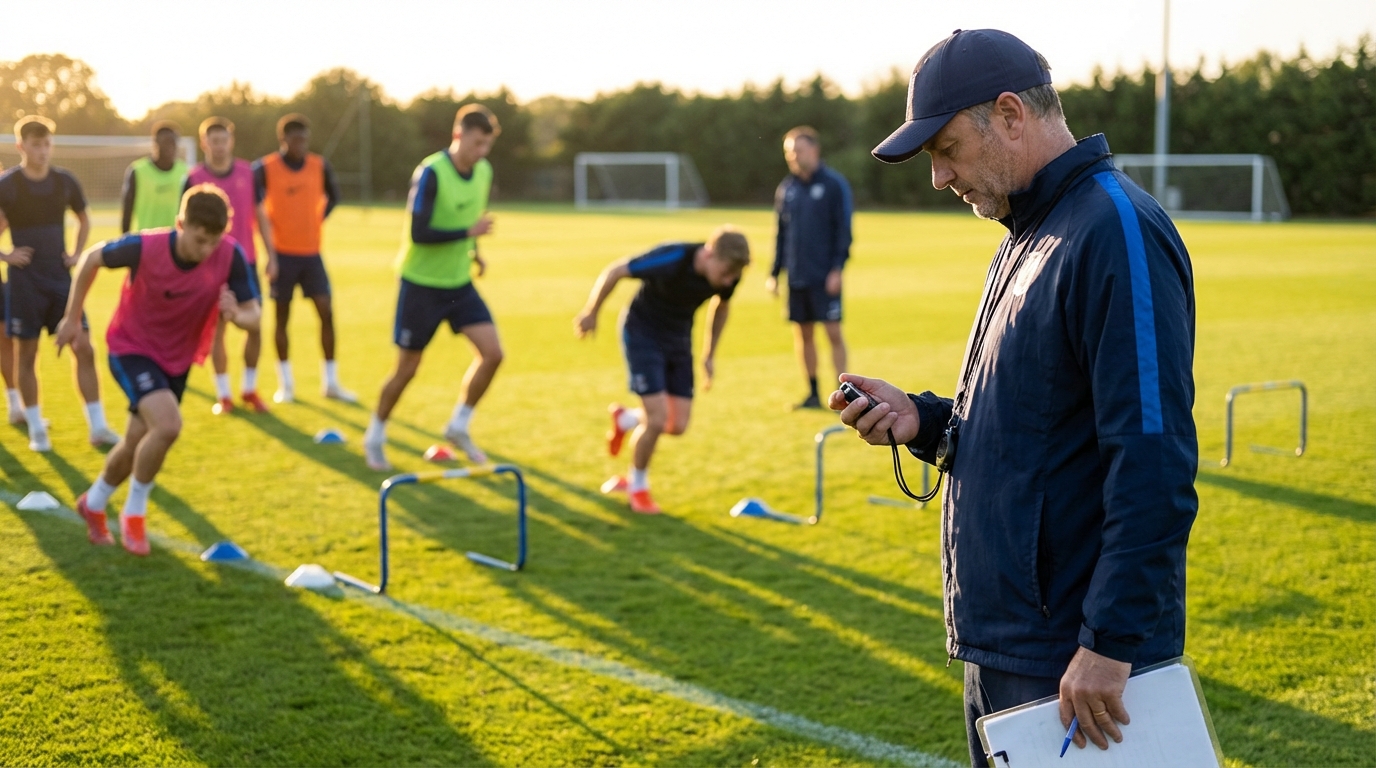
At its simplest, load management means controlling how hard your players work across a week, a month, and a season. It's the balance between training stress and recovery. Push too hard without enough rest and players break down. Go too easy and they don't improve.
Professional clubs use GPS trackers that measure distance covered, sprint counts, and acceleration loads. You don't need any of that. What you need is awareness and a simple system to vary your session intensity.
RPE: Your Free Load Management Tool
Rate of Perceived Exertion (RPE) is a scale from 1-10 where players rate how hard a session felt. It costs nothing, takes 30 seconds, and gives you genuinely useful data about your training load.
After each session, ask your players to rate the intensity:
- 1-2: Very light - could do this all day (gentle warm-ups, walking activities)
- 3-4: Light to moderate - comfortable effort (technical work, low-pressure possession)
- 5-6: Moderate - noticeably working but sustainable (conditioned games, position-specific work)
- 7-8: Hard - breathing heavily, legs feeling it (high-intensity small-sided games, fitness work)
- 9-10: Maximum - couldn't do much more (sprint sessions, match-intensity scenarios)
Multiply the RPE by session duration in minutes and you get a "session load" number. A 60-minute session rated 7 gives a load of 420. Track this over time and you'll spot patterns.
Periodisation Basics: Hard, Medium, Easy
Periodisation is a fancy word for a simple idea: don't train at the same intensity every session. Vary it deliberately across the week and across the month.
If you train twice a week with a match on Saturday, a basic structure looks like this:
- Tuesday: Higher intensity - tactical work, game scenarios, match preparation (RPE target: 7-8)
- Thursday: Lower intensity - technical work, set pieces, lighter possession games (RPE target: 4-5)
- Saturday: Match day (RPE will naturally be 8-9)
Monthly Periodisation
Across a four-week block, vary the overall load:
- Week 1: Medium load - establish baseline
- Week 2: High load - push the intensity, more demanding sessions
- Week 3: High load - peak training week
- Week 4: Low load - recovery week, lighter sessions, more fun activities
That fourth week is crucial. It's where adaptation happens. Players don't get fitter during hard training - they get fitter during recovery from hard training. Skip the easy weeks and you'll see injuries, fatigue, and players dropping out.
How to Vary Session Intensity
Making a Session Harder
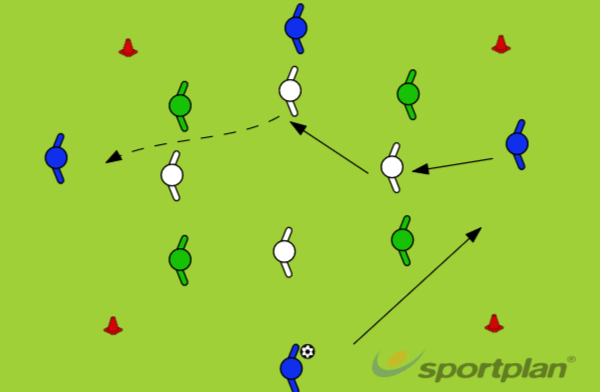
Reduce pitch size (less recovery time between actions), increase player numbers in small spaces, add transition rules that demand immediate pressing, use shorter rest periods between activities, and set competitive conditions with consequences.
Making a Session Easier
Increase pitch size (more time on the ball), reduce numbers (fewer interactions), allow more touches, include longer water breaks, focus on technical repetition without opposition, and use walking-pace cool-down games.
Signs of Overtraining in Amateur Players
Professional players have blood tests and wellness questionnaires. At grassroots level, you need to watch for these warning signs:
- Repeated minor injuries: Tight hamstrings, sore knees, and niggling strains that won't clear up often signal accumulated fatigue, not bad luck
- Drop in enthusiasm: Players who used to arrive early now turn up late or skip sessions - this is often mental fatigue, not laziness
- Performance plateau: Despite regular training, players seem to be getting worse or standing still rather than improving
- Increased illness: Frequent colds and infections can indicate an overloaded immune system from excessive training stress
- Poor sleep and mood: Ask your players how they're sleeping - disrupted sleep is one of the earliest signs of overtraining
Practical Tips for Grassroots Coaches
Account for Multi-Sport Players
Your U12 midfielder might also play basketball on Wednesdays and have PE twice a week. That's training load you didn't prescribe but still affects their body. Ask players what other physical activity they do and factor it into your planning.
Pre-Match Sessions Should Be Light
The session before a match should never be the hardest of the week. Focus on sharpness, set pieces, and tactical reminders. Save the high-intensity work for earlier in the week when there's time to recover.
Use the 10% Rule
Don't increase weekly training load by more than 10% from one week to the next. Sudden spikes in load - such as adding an extra session or dramatically increasing intensity - are the biggest predictor of soft tissue injuries.
Talk to Your Players
The simplest load management tool is conversation. "How are your legs feeling?" before training starts tells you more than any tracking device. If half the squad says they're exhausted, adjust your plan.
Frequently Asked Questions
Is load management relevant for youth teams?
It's arguably more important for youth teams. Young players are still growing, and their bodies are more susceptible to overuse injuries. Keep sessions varied, ensure adequate rest days, and never punish players with extra running - it adds uncontrolled load.
How do I use RPE if players always say "10" or "2" to be funny?
Educate them on the scale first. Explain that a 10 means they physically couldn't do another minute. Most players quickly learn to be honest once they understand the purpose. You can also use a simpler traffic light system: green (easy), amber (moderate), red (very hard).
What if we only train once a week?
With one session plus a match, your main concern is making sure training doesn't leave players exhausted for the weekend. Keep mid-week sessions at moderate intensity (RPE 5-6) and let the match provide the high-intensity stimulus. Focus training time on tactical and technical work rather than fitness.
Should I cancel training if players seem tired?
Don't cancel - adapt. Switch a planned high-intensity session to a technical or tactical focus at lower intensity. Light ball work, set piece practice, or a fun game with minimal running still has huge value. Sometimes a lighter session is the best session you'll run all season.